21
Aug
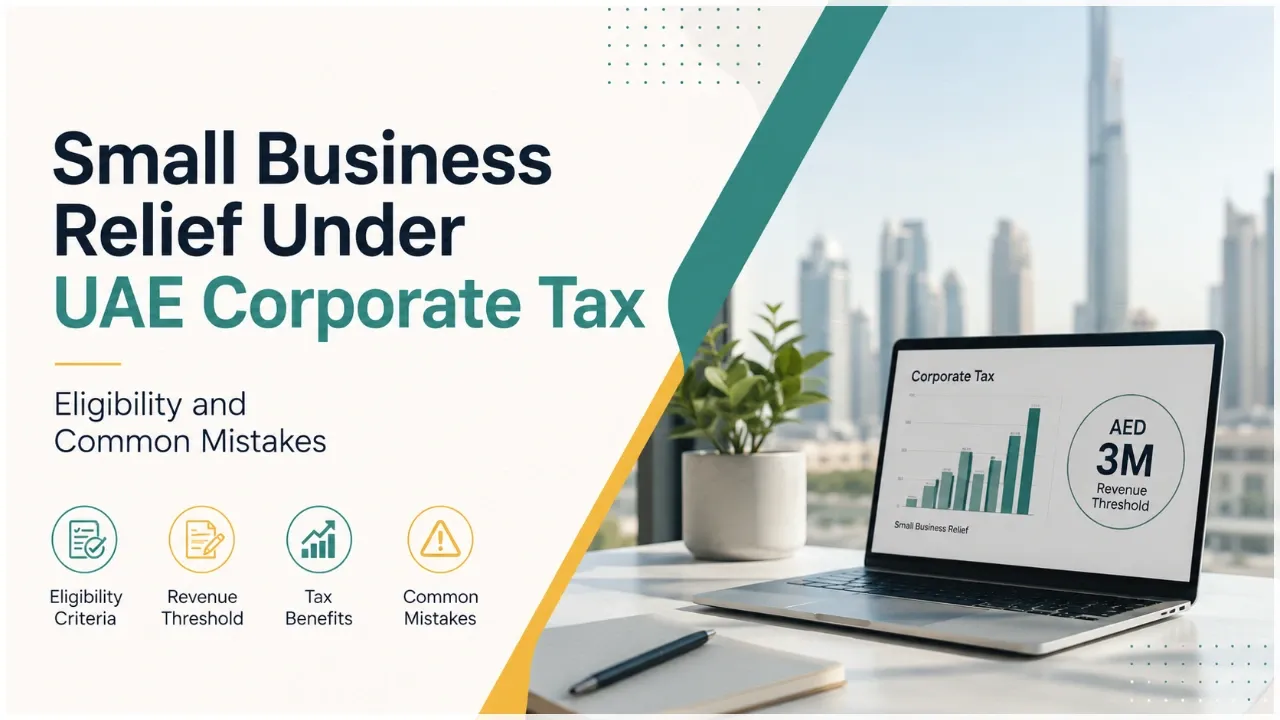
Small Business Relief Under UAE Corporate Tax: Eligibility and Common Mistakes
The UAE Corporate Tax system includes a special measure designed to reduce the tax and compliance burden on smaller resident businesses: Small Business Relief.
For eligible businesses, the relief can mean that the business is treated as having no Taxable Income for the relevant Tax Period. However, Small Business Relief is not automatic. A business must meet the eligibility conditions, make the required election in its Corporate Tax return, and maintain records that support its eligibility.
The Federal Tax Authority (FTA) has also recently clarified that businesses benefiting from Small Business Relief still need to submit the required simplified Corporate Tax return within the prescribed deadline. (FTA UAE)
This guide explains who can benefit, how the AED 3 million revenue threshold works, what businesses need to do, and the common mistakes that can cause problems.
What Is Small Business Relief in the UAE?
Small Business Relief is a Corporate Tax relief available to certain UAE resident persons with relatively low business revenue.
When an eligible business elects for the relief, it is treated as having no Taxable Income for the relevant Tax Period. This can significantly reduce the Corporate Tax burden and simplify some compliance requirements.
However, it is important to understand that Small Business Relief is different from the UAE's standard 0% Corporate Tax rate on taxable income up to AED 375,000.
Under the normal Corporate Tax rules:
- Taxable income up to AED 375,000 is subject to 0% Corporate Tax.
- Taxable income above AED 375,000 is generally subject to 9%.
- Small Business Relief, where available and properly elected, treats the eligible business as having no Taxable Income for that Tax Period. (FTA UAE)
This distinction is important when deciding how the relief applies to a business.
Who Is Eligible for Small Business Relief?
The main eligibility conditions are straightforward, but businesses need to check every condition carefully.
1. The business must be a UAE Resident Person
Small Business Relief is available to qualifying UAE Resident Persons, including resident natural persons and juridical persons.
A business operating through a UAE company may therefore potentially qualify if the other conditions are satisfied.
A non-resident person does not qualify simply because it has customers or business connections in the UAE. The residence status for Corporate Tax purposes must be considered.
2. Revenue must not exceed AED 3 million
The key threshold is AED 3 million.
A business can generally elect for Small Business Relief when its Revenue is AED 3 million or less in:
- The relevant current Tax Period; and
- All previous Tax Periods ending on or before 31 December 2026. (FTA UAE)
This means checking only the current year's revenue is not enough.
For example, suppose a Dubai business has:
- 2024 Revenue: AED 2.2 million
- 2025 Revenue: AED 2.7 million
- 2026 Revenue: AED 2.9 million
If all other conditions are satisfied, the business may be eligible for Small Business Relief for the relevant period.
Now consider another business:
- 2025 Revenue: AED 3.4 million
- 2026 Revenue: AED 2.1 million
Even though the 2026 revenue is below AED 3 million, the previous period exceeded the threshold. The business would therefore not qualify for Small Business Relief for 2026. The FTA provides a similar example in its guidance. (FTA UAE)
Important: Small Business Relief Is Currently Time-Limited
One of the most important points businesses should understand is that the current Small Business Relief framework is linked to Tax Periods ending on or before 31 December 2026.
The FTA's published Small Business Relief guide states that the relief applies to relevant Tax Periods beginning on or after 1 June 2023 and ending on or before 31 December 2026, subject to the eligibility conditions. (FTA UAE)
Therefore, businesses should not assume that the same relief will automatically continue for later Tax Periods.
As UAE Corporate Tax rules and guidance can develop, businesses should check the latest FTA announcements before making future tax decisions.
Who Cannot Claim Small Business Relief?
Not every small business qualifies.
The FTA specifically excludes certain categories from Small Business Relief, including:
- Qualifying Free Zone Persons.
- Members of a multinational enterprise group where the consolidated group revenue exceeds AED 3.15 billion. (FTA UAE)
This means that simply having revenue below AED 3 million does not automatically make every company eligible.
Businesses operating from free zones should pay particular attention to their Corporate Tax status before assuming that Small Business Relief is available.
How Does the Relief Work?
Small Business Relief effectively allows an eligible business to be treated as having no Taxable Income for the relevant Tax Period.
For example, imagine a UAE resident company with:
- Revenue: AED 2.8 million
- Allowable business costs: AED 1.8 million
- Profit: AED 1 million
Without Small Business Relief, the business may have a Corporate Tax liability depending on its taxable income after applying the Corporate Tax rules.
If the company is eligible and properly elects for Small Business Relief, it can instead be treated as having no Taxable Income for that period.
The FTA's guidance illustrates that the value of the relief depends on the profitability of the business. A company with higher taxable profit can potentially receive a larger tax benefit than a company with a very small profit. (FTA UAE)
Small Business Relief Does Not Mean "No Tax Compliance"
This is one of the biggest misunderstandings among small businesses.
A business should not assume:
"My revenue is below AED 3 million, so I don't need to do anything."
That is incorrect.
In August 2026, the FTA specifically confirmed that Taxable Persons eligible for Small Business Relief must still submit the required simplified Corporate Tax return within the prescribed legal deadline. The relief reduces the information and tax calculation burden, but it does not remove the filing obligation. (FTA UAE)
Businesses should therefore continue to maintain proper accounting and tax records.
Common Mistakes Businesses Make
1. Checking Only the Current Year's Revenue
This is probably the most common mistake.
A business may generate AED 2.5 million this year and assume it qualifies. But if its revenue exceeded AED 3 million in a relevant previous Tax Period, the business may not be eligible.
Always review the current and applicable previous Tax Periods before making the election.
2. Assuming the Relief Is Automatic
Small Business Relief is an election.
An eligible business must elect for the relief through its Corporate Tax return. The FTA's guidance states that if an eligible business submits its return without electing for the relief, it cannot simply claim the benefit later for that Tax Period. (FTA UAE)
This makes accurate tax-return preparation particularly important.
3. Confusing Revenue With Profit
The AED 3 million test is based on Revenue, not profit.
For example:
Business A:
- Revenue: AED 2.9 million
- Profit: AED 1.2 million
Business B:
- Revenue: AED 3.2 million
- Profit: AED 100,000
Business A may meet the revenue condition, while Business B may fail it even though Business B has a much smaller profit.
4. Assuming Free Zone Businesses Automatically Qualify
Free zone businesses need to examine their Corporate Tax classification carefully.
A Qualifying Free Zone Person cannot elect for Small Business Relief. Therefore, businesses should not choose a relief simply because their revenue is below AED 3 million. (FTA UAE)
5. Forgetting Corporate Tax Registration
Another common misconception is that a business receiving Small Business Relief does not need Corporate Tax registration.
The FTA guidance explains that a business seeking to benefit from the relief must be registered for Corporate Tax and obtain a Tax Registration Number so that it can make the election in its Tax Return. (FTA UAE)
Corporate Tax registration and tax relief are two separate matters.
6. Not Keeping Revenue Records
Businesses should be able to demonstrate that they meet the AED 3 million threshold.
Proper records may include:
- Sales invoices
- Bank statements
- Accounting records
- Customer receipts
- Sales reports
- Credit notes
- Other supporting financial documents
Good bookkeeping makes it much easier to prove eligibility if the FTA asks for supporting information.
7. Ignoring the Filing Deadline
Small Business Relief does not remove the requirement to submit the relevant return.
A business that qualifies for the relief should still prepare its records, make the appropriate election, and submit the simplified Corporate Tax return within the applicable deadline. (FTA UAE)
Missing a deadline can create unnecessary compliance issues even when the business ultimately has no Corporate Tax payable.
A Simple Eligibility Checklist
Before claiming Small Business Relief, a business can review the following:
- Is the business a UAE Resident Person for Corporate Tax purposes?
- Is the current relevant Tax Period revenue AED 3 million or less?
- Are the applicable previous Tax Period revenues also AED 3 million or less?
- Is the business excluded because it is a Qualifying Free Zone Person?
- Is it part of a multinational group exceeding the applicable consolidated revenue threshold?
- Is the business registered for Corporate Tax?
- Are sufficient revenue and accounting records available?
- Will the Small Business Relief election be correctly made in the Corporate Tax return?
- Will the required return be submitted within the legal deadline?
If there is uncertainty about any of these points, professional tax advice can help prevent an incorrect election.
Practical Example: A Dubai Consultancy
Consider a small consultancy based in Dubai.
Its revenue is:
- 2024: AED 1.6 million
- 2025: AED 2.1 million
- 2026: AED 2.6 million
The company is a UAE Resident Person and does not fall into an excluded category.
Because its revenue remains within the AED 3 million threshold for the relevant periods, it may qualify for Small Business Relief.
However, the company still needs to:
- Maintain proper accounting records.
- Be registered for Corporate Tax.
- Prepare the required Corporate Tax return.
- Make the Small Business Relief election correctly.
- Submit the return within the applicable deadline.
The lesson is simple: eligibility for relief reduces the tax burden, but it does not eliminate the need for proper compliance.
How Small Businesses Can Avoid Problems
A simple compliance system can prevent most mistakes.
Keep monthly accounts
Do not wait until the end of the year to calculate revenue. Monthly bookkeeping makes it easier to see whether revenue is approaching the AED 3 million threshold.
Track revenue separately from profit
Your accounting system should clearly distinguish sales revenue from expenses and profit.
Review previous Tax Periods
Before claiming the relief, check historical revenue records rather than relying only on the current year's figures.
Check your Corporate Tax status
Free zone businesses, companies within groups, and businesses with unusual ownership structures should confirm their eligibility carefully.
File on time
Even when no Corporate Tax is expected to be payable because of Small Business Relief, the required return still needs to be submitted.
Conclusion
Small Business Relief can provide valuable support to eligible UAE businesses by reducing Corporate Tax and simplifying certain compliance requirements. But the relief should not be treated as an automatic exemption.
The AED 3 million revenue threshold, previous-period revenue test, resident-person requirement, excluded categories, election requirement and filing obligations all need to be considered.
For UAE small businesses, the safest approach is to maintain accurate books, monitor revenue throughout the year and review Corporate Tax eligibility before submitting the return.
Because UAE tax rules and FTA guidance can change, businesses should also check the latest official FTA information when preparing their Corporate Tax compliance.
Frequently Asked Questions
1. What is the revenue limit for UAE Small Business Relief?
The current Small Business Relief rules use an AED 3 million Revenue threshold for the relevant Tax Period and applicable previous Tax Periods ending on or before 31 December 2026.
2. Is Small Business Relief automatic?
No. An eligible business must make the appropriate election in its Corporate Tax return.
3. Do businesses claiming Small Business Relief still need to file a Corporate Tax return?
Yes. The FTA confirmed in August 2026 that eligible businesses must continue to submit the required simplified Corporate Tax return within the prescribed deadline.
4. Can a Qualifying Free Zone Person claim Small Business Relief?
No. Qualifying Free Zone Persons are specifically excluded from electing for Small Business Relief.
5. Does revenue mean profit for the AED 3 million test?
No. The threshold is based on Revenue, not profit. A business must review its revenue figures when determining eligibility.
Keep Your UAE Corporate Tax Compliance on Track
Understanding Small Business Relief is only one part of managing Corporate Tax obligations in the UAE. Proper bookkeeping, accurate revenue records and timely filing can help your business avoid unnecessary compliance problems.
Get professional assistance to review your Corporate Tax position, assess Small Business Relief eligibility and prepare your tax compliance correctly.