21
Oct
How to Transfer a Company from a UAE Free Zone to Dubai Mainland
As commercial enterprises expand their operational footprint across the United Arab Emirates, business owners frequently re-evaluate their corporate jurisdiction. Many companies initially incorporate within one of the UAE's specialized free trade zones, attracted by cost-effective startup packages, zero customs barriers, and simplified administrative onboarding. However, as business maturity increases, the territorial boundaries of free zone licensing can present strategic limitations. A free zone company cannot trade physical goods directly within the local mainland market without appointing a commercial distributor, nor can it open retail showrooms, bid freely on lucrative government procurement contracts, or establish offices across Dubai's bustling commercial districts.
Historically, transitioning from a free zone to mainland Dubai required a cumbersome and disruptive process: liquidating the existing free zone entity, terminating employee residence visas, closing bank accounts, and incorporating an entirely new mainland company from scratch. Recognizing the commercial friction of this approach, the Department of Economy and Tourism (DET) and leading UAE free zone authorities enacted modern corporate conversion and continuation frameworks under Federal Decree-Law No. 32 of 2021 on Commercial Companies. Today, businesses can legally transfer, convert, or restructure their operational presence into a mainland Limited Liability Company (LLC) while preserving corporate goodwill, operational continuity, and commercial contracts.
Why Transition from a Free Zone to Dubai Mainland?
Corporate founders and international enterprises pursue mainland conversion driven by substantial strategic catalysts:
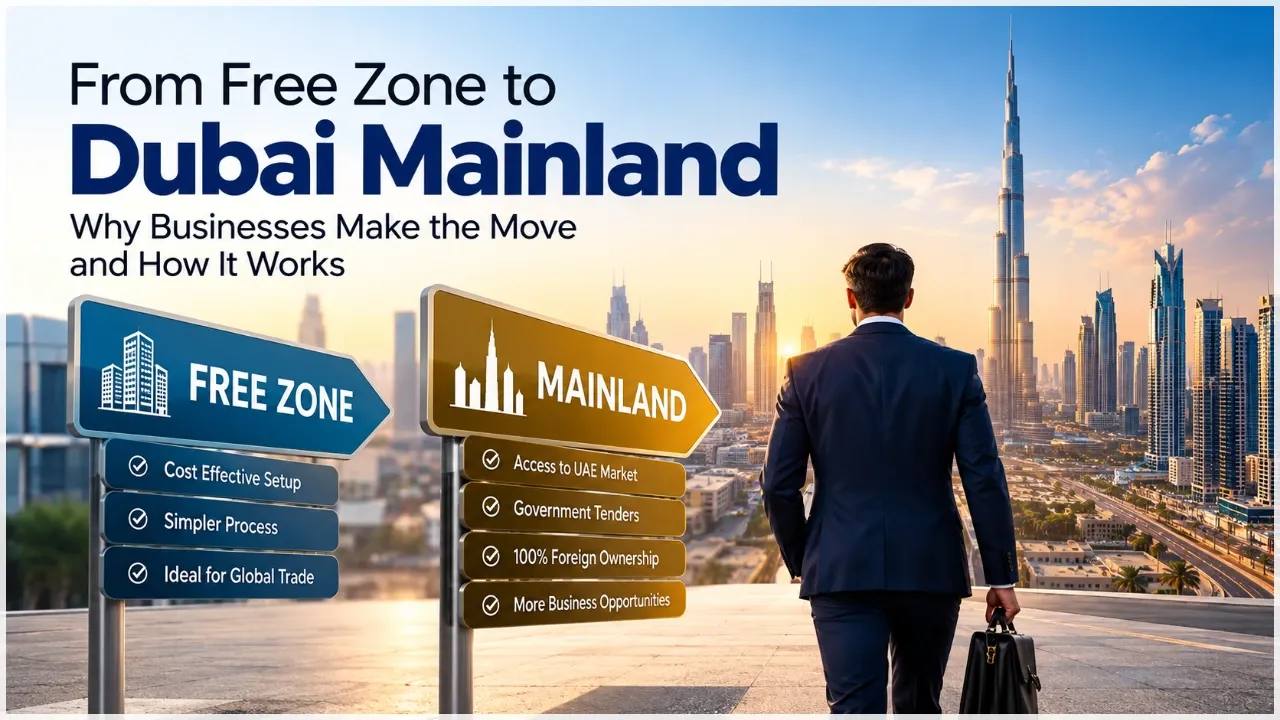
- Unrestricted Domestic Market Access: Mainland licensing allows companies to trade directly with consumers (B2C) and corporate clients (B2B) across the entire UAE without incurring mainland customs duties or relying on local distributors.
- Eligibility for Government Tenders: Major federal ministries, municipal bodies, and semi-government entities (such as Dubai Holding or DEWA) require suppliers to hold active mainland trade licenses to participate in high-value procurement bids.
- 100% Foreign Ownership Protection: Landmark reforms to the UAE Commercial Companies Law grant foreign investors 100% ownership of mainland commercial and industrial entities, eliminating the historical necessity of a local sponsor.
- Premise Flexibility Across Dubai: Mainland businesses can lease commercial space, retail outlets, or corporate headquarters anywhere in Dubai—from Downtown and Business Bay to Sheikh Zayed Road and Al Quoz—authenticated through standard Ejari agreements.
- Corporate Banking and Capital Access: Mainland entities enjoy enhanced credit profiling, broader trade finance facilities, and simplified compliance reviews with domestic commercial banking institutions.
Three Strategic Legal Pathways for Transitioning to Mainland
Depending on the company's asset profile, existing contracts, and licensing authority regulations, management teams can select from three primary legal restructuring mechanisms:
| Restructuring Mechanism | Legal Framework | Core Operational Impact |
|---|---|---|
| Direct Company Continuation (Migration) | Re-domiciliation of the legal entity from Free Zone to DET under Commercial Companies Law | Preserves original corporate identity, historical credit profile, existing contracts, and operational longevity without liquidation |
| Establishing a Mainland Branch Office | Opening a mainland branch owned 100% by the existing parent Free Zone company | Free zone parent remains active; mainland branch conducts operations, signs domestic leases, and accesses mainland clients |
| Structured Parallel Setup & Asset Transfer | Incorporating a new mainland LLC followed by structured novation of contracts and visa transfers | Allows selective asset migration, debt segregation, and seamless client onboarding while winding down legacy operations |
Managing Existing Employee Visas and MoHRE Integration
One of the most sensitive phases in transferring from a free zone to mainland Dubai is managing human resources and employee residency files. Because free zone visas are governed directly by the respective Free Zone Authority and GDRFA, while mainland visas are regulated by the Ministry of Human Resources and Emiratisation (MoHRE), workforce migration must be planned with precision:
- Establishing the MoHRE Establishment Card: Once the mainland trade license is issued, the company registers with MoHRE to open its corporate labor file, unblocking employee visa quotas and establishing its Wage Protection System (WPS) routing.
- Coordinating Visa Transitions Without Departure: Employees do not need to exit the UAE during the transition. Once the mainland company file is activated, free zone residency visas can be canceled in synchronized batches. Mainland entry permits are generated immediately, followed by internal status changes, medical screening updates, and updated Emirates ID registrations.
- Preserving Employment Service Continuity: Employment contracts transferred to the mainland entity must explicitly state whether prior service in the free zone is recognized for calculating statutory end-of-service gratuity, ensuring full labor law transparency.
Step-by-Step Mainland Transition Roadmap
Executing a successful corporate transition requires structured inter-agency coordination between the Free Zone Authority and DET.
Step 1: Passing Board Resolutions and Free Zone NOC
The company's shareholders must pass a formal Board Resolution approving the conversion, continuation, or branch establishment in mainland Dubai. Submit this resolution to the Free Zone Authority to secure an official No Objection Certificate (NOC) and clearance certificate.
Step 2: DET Initial Approval and Trade Name Reservation
Submit the Free Zone NOC, shareholder identification records, and proposed company name to the Department of Economy and Tourism. The trade name can match the existing free zone brand, subject to standard DET naming and trademark checks.
Step 3: Leasing Mainland Office Space and Ejari Authentication
Mainland commercial licensing requires a physical business address in Dubai. Secure an approved commercial office, retail showroom, or business center executive desk. The commercial lease must be registered and authenticated through the Dubai Land Department's Ejari portal.
Step 4: Drafting and Notarizing the Mainland MOA
Draft the new mainland Memorandum of Association (MOA) in bilingual Arabic and English. Shareholders execute the MOA digitally through Dubai Courts Notary Public systems using secure UAE Pass authentication.
Step 5: DET Trade License Generation and Bank Account Setup
Submit all finalized documents to DET to generate your official Dubai Mainland Trade License. With the license issued, open a mainland corporate bank account or update existing banking mandates, novate client contracts, and register for corporate tax and VAT on the EmaraTax portal.
Novating Commercial Contracts and Banking Mandates
To ensure commercial revenues continue uninterrupted, management must execute formal Contract Novation Agreements with existing clients and vendors. Novation transfers all contractual rights, payment obligations, and service liabilities from the legacy free zone entity to the new mainland company. Furthermore, corporate banks must be provided with the new mainland license, notarized MOA, and updated trade registers to transfer corporate credit lines, merchant point-of-sale terminals, and corporate credit cards seamlessly.
Corporate Tax Implications: Transitioning from Free Zone to Mainland
A critical strategic consideration when transferring a company from a UAE free zone to Dubai Mainland is evaluating the transition under Federal Decree-Law No. 47 of 2022 on Corporate Tax. While eligible free zone entities can potentially enjoy 0% corporate tax on qualifying income under the Qualifying Free Zone Person (QFZP) framework, establishing a mainland operational presence brings the business directly into the standard 9% corporate tax regime on taxable profits exceeding AED 375,000.
Finance leaders must prepare an opening mainland tax balance sheet in accordance with International Financial Reporting Standards (IFRS). If the business maintains operations in both the free zone and mainland, leadership must evaluate whether establishing a Corporate Tax Group is advantageous. Forming a tax group allows parent and subsidiary entities to be treated as a single taxable person, consolidating financial results, offsetting subsidiary losses against profitable entities, and eliminating transfer pricing compliance burdens on intra-group transactions. Updating your tax registrations proactively on the Federal Tax Authority's EmaraTax platform ensures seamless tax continuity and prevents late filing penalties.
Partnering with Experienced Corporate PRO Specialists
Transferring a business from a free zone to mainland Dubai is a transformative corporate milestone that unlocks unlimited commercial horizons. However, coordinating free zone clearances, MoHRE file setups, employee visa transfers, and commercial contract novations requires experienced regulatory oversight. Partnering with seasoned corporate setup and government PRO specialists ensures your transition is executed smoothly, cost-effectively, and without operational disruption, positioning your enterprise for boundless growth across the UAE.
Frequently Asked Questions
Can I transfer a free zone company to Dubai Mainland without closing it?
Yes. Under modern UAE company continuation and branch setup frameworks, you can re-domicile the legal entity or establish a 100% owned mainland branch without liquidating the free zone company.
What happens to employee visas during a free zone to mainland transfer?
Employee visas can be transferred smoothly without exiting the country. Once the mainland company establishes its MoHRE file, visas are canceled from the free zone and re-issued under the mainland entity.
Can foreigners own 100% of the new mainland company?
Yes. Under current UAE Commercial Companies Law, foreign investors can hold 100% foreign ownership of commercial and professional mainland LLCs without requiring a local Emirati partner.
Do I need a physical office in mainland Dubai?
Yes. Mainland licensing requires a physical commercial premises authenticated through an official Ejari certificate, which can range from an executive desk in a business center to private office space.
Do I need to inform the Federal Tax Authority (FTA) about the transfer?
Yes. Corporate tax and VAT registration records must be updated or linked through the EmaraTax portal to reflect the updated mainland trade license and commercial structure.
Ready to Expand Your Free Zone Business into Dubai Mainland?
Right Time Business Setup guides companies through free zone NOCs, DET mainland licensing, MoHRE workforce transitions, Ejari office leasing, and corporate bank onboarding. Contact our corporate restructuring specialists today.
Start Mainland Transfer