13
Oct
How to Register and Authenticate Ejari Online for Dubai Commercial Properties
Securing a valid commercial lease in Dubai is one of the most critical operational milestones for any business, whether establishing a new headquarters, opening a retail showroom, or leasing a commercial warehouse. Under Dubai law, every commercial tenancy contract must be formally recorded and authenticated through the Ejari system. Ejari, which translates to "my rent" in Arabic, is the official regulatory framework initiated by the Dubai Land Department (DLD) and the Real Estate Regulatory Agency (RERA) to govern landlord-tenant relationships and protect contractual transparency across the emirate.
For corporate entities, Ejari authentication is not merely a formality for occupying premises. It represents a mandatory statutory prerequisite required by the Department of Economy and Tourism (DET), the Ministry of Human Resources and Emiratisation (MoHRE), civil defense authorities, and major commercial banking institutions. Without an active Ejari certificate tied directly to the commercial property's Dubai Electricity and Water Authority (DEWA) premise number, a business cannot issue or renew its trade license, secure company establishment cards, or obtain employee residence visas.
Understanding Commercial Ejari vs Residential Attestation
While residential tenants frequently complete Ejari registration independently through simple mobile applications, commercial tenancy registration involves stringent corporate compliance parameters. Commercial leases govern physical spaces intended for economic activities, which introduces layered regulatory responsibilities involving both the licensing jurisdiction and municipal health, safety, and operational standards.
Key differences between commercial and residential Ejari registration include:
- Licensing Authority Cross-Verification: Commercial Ejari requires precise alignment between the permitted zoning activities of the premises and the economic activities listed on the tenant's trade license or initial approval certificate.
- Premise Allocation and Desk Space Compliance: Commercial office buildings, business centers, and shared executive workspaces operate under strict desk-to-visa quota ratios governed by DET and MoHRE regulations.
- DEWA Premise Integration: Commercial properties require dedicated corporate utility accounts and sub-meter certifications before authentication can be completed.
- Corporate Ownership Records: Landlords must provide verified title deeds, while corporate tenants must supply trade license documentation, authorized signatory appointments, and valid passport or Emirates ID records for all company representatives.
Step-by-Step Online Workflow for Commercial Ejari Registration
The Dubai Land Department provides digital access through the official DLD smart portal and designated trustee centers, allowing property managers, corporate tenants, and authorized typing specialists to submit and authenticate tenancy contracts online. Following a structured procedure prevents administrative delays and avoids contract rejection.
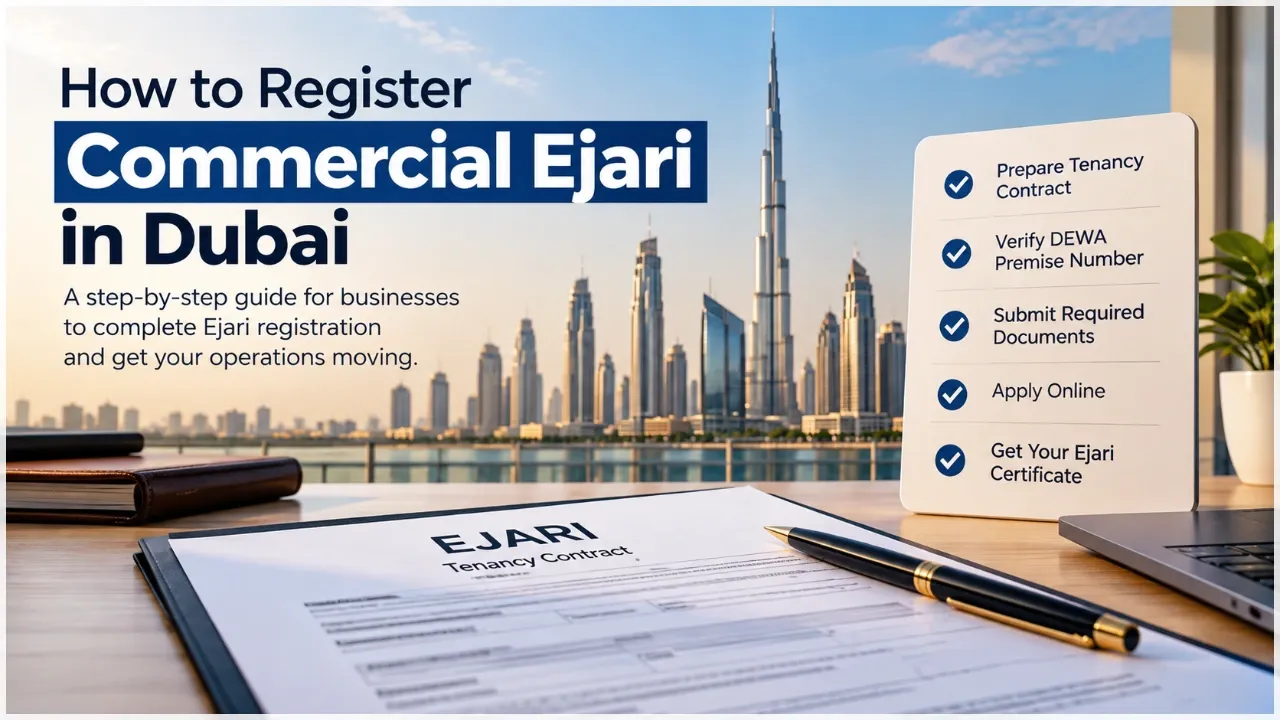
Step 1: Unification of the Tenancy Contract
The foundation of a successful Ejari submission is the unified tenancy contract. Both landlord and tenant must negotiate, finalize, and sign the standard unified tenancy agreement alongside any custom corporate addendums. It is vital that party names, company registration numbers, payment schedule terms, maintenance obligations, and property identifiers match government records exactly.
Step 2: DEWA Premise Number Verification
Every commercial unit in Dubai possesses a unique 9-digit DEWA premise number affixed to the entrance of the property. During online registration, this number is entered into the DLD portal to verify that the building is structurally registered, clear of past municipal liabilities, and linked to the active title deed held on file.
Step 3: Compiling Mandatory Documentation
Prior to submitting the digital application, corporate tenants must gather high-resolution electronic copies of all necessary compliance documents. Missing documentation or expired signatory identifications represent the most frequent cause of processing postponements.
Step 4: Portal Application Submission and Verification
The application is submitted via the DLD portal or through an accredited typing and government service center. The system cross-references the submitted data against municipal zoning maps and DLD title registries. Upon initial electronic verification, the tenancy details undergo review by DLD audit officers to confirm compliance with land-use regulations.
Step 5: Certificate Issuance and System Synchronization
Once approved, the official Ejari certificate is generated instantly in downloadable format. The document includes a unique Ejari contract number, a scannable verification barcode, and the assigned DEWA premise details. Crucially, the Ejari database automatically synchronizes with the DET corporate registry and DEWA customer management systems, instantly unblocking downstream business setup and licensing procedures.
Commercial Ejari Document Checklist
To ensure uninterrupted authentication, corporate tenants should organize their documentation according to the following comprehensive checklist:
| Required Document | Issuing Authority / Origin | Primary Regulatory Purpose |
|---|---|---|
| Original Signed Tenancy Contract | Landlord and Tenant | Legal proof of lease terms and property handover agreements |
| Title Deed or Affection Plan | Dubai Land Department (DLD) | Verification of legal ownership and permissible property usage |
| Tenant Trade License or Initial Approval | DET or Free Zone Authority | Confirmation of authorized business entity and company status |
| Passport & Emirates ID Copies | ICP / Respective Embassies | Identity verification of authorized signatories and company managers |
| DEWA 9-Digit Premise Number | DEWA Plate on Premises | Property location linkage and utility infrastructure synchronization |
| Trade License of Landlord / Management | DET / Commercial Registry | Applicable when renting from corporate leasing companies or business centers |
Integrating DEWA Utilities with Your Commercial Ejari
A major advancement in Dubai's government services ecosystem is the automated digital linkage between Ejari and DEWA utility activation. When a commercial Ejari contract is successfully authenticated, an automated electronic notification is transmitted to DEWA systems.
Upon receipt of the Ejari notification, DEWA generates a corporate move-in file and dispatches an account activation link via SMS and email to the tenant's registered contact details. The business can then activate its commercial water and electricity connection seamlessly. Maintaining accurate mobile numbers and email addresses on company documentation is therefore essential to prevent operational disruptions.
Common Reasons for Commercial Ejari Rejection
Navigating commercial tenancy registration requires careful attention to regulatory nuances. Corporate tenants frequently encounter administrative hurdles due to avoidable oversights, including:
- Activity and Zoning Mismatches: Attempting to register industrial or high-traffic commercial activities in spaces designated strictly for administrative office use will trigger an immediate system rejection.
- Overlapping Active Tenancy Records: If a previous tenant vacated the commercial unit without formally canceling their existing Ejari certificate, the DLD system will prevent new registrations until the legacy contract is deregistered.
- Discrepancies in Signatory Powers: Contracts signed by individuals without documented Power of Attorney (POA) or authorized manager status on the commercial license cannot be authenticated.
- Unregistered Subleases: Leasing space within a shared facility or business center without verified DLD sub-leasing approvals creates severe licensing roadblocks.
- Expired Title Deeds or Unresolved Mortgages: If ownership documentation has not been digitized or updated following mortgage adjustments, manual verification delays will occur.
Commercial Lease Renewal and Ejari Cancellation Protocols
Maintaining regulatory compliance extends beyond the initial registration of your commercial tenancy agreement. In Dubai, corporate leases must be re-authenticated through the Ejari system annually upon renewal. Failing to renew the Ejari certificate in tandem with your commercial lease triggers automatic administrative holds on your company's Department of Economy and Tourism (DET) portal, preventing the renewal of your commercial trade license, blocking new employee visa quotas, and risking municipal penalties.
Furthermore, when a business vacates a commercial space or relocates to larger corporate headquarters, the tenant must formally execute an Ejari cancellation request. A commercial lease cannot simply be abandoned upon expiry. Proper cancellation requires submitting a formal lease termination notice signed by both parties, an authenticated final utility clearance certificate from DEWA confirming zero outstanding electricity or water arrears, and a landlord security deposit settlement letter. Ensuring prompt Ejari cancellation releases the commercial premise in the DLD database, allowing the property owner to re-lease the space and enabling the tenant to register their new commercial location without conflicting premise errors.
Strategic Best Practices for Dubai Business Tenants
Before executing commercial leases, corporate decision-makers should conduct comprehensive due diligence on the prospective property. Confirm that the landlord holds a valid, digitized title deed and that no outstanding utility liabilities or municipal violations attach to the premise number. Ensure that the leased square footage aligns with your company's long-term staffing projections, as DET and MoHRE allocate employee visa quotas directly based on authenticated commercial space.
Engaging professional typing and government service specialists simplifies the entire authentication roadmap. Expert consultants verify title compliance, review contract terms against municipal guidelines, manage digital submissions, and resolve overlapping registration conflicts efficiently, allowing enterprise leadership to concentrate on core commercial operations.
Frequently Asked Questions
Can I register commercial Ejari online without a trade license?
Yes, if you are setting up a new business, you can use your initial approval certificate and trade name reservation issued by the licensing authority to complete commercial Ejari registration.
How long does it take to authenticate a commercial Ejari online?
When all documents including the signed tenancy contract, title deed, and DEWA premise number are accurate, digital Ejari authentication is typically processed within 24 to 48 hours.
What happens if the previous tenant did not cancel their Ejari?
The new registration cannot proceed while an active contract exists on the same premise. The landlord or tenant must submit a cancellation request accompanied by proof of lease termination to clear the record.
Does commercial Ejari automatically connect DEWA electricity and water?
Ejari authentication automatically creates a move-in request in DEWA systems, prompting an activation link to be sent to the tenant to complete utility connection seamlessly.
Can a virtual office or flexi-desk obtain an Ejari certificate?
Dedicated commercial leases receive standard Ejari certificates. Business centers and shared co-working spaces issue specialized tenancy agreements governed by DLD and licensing authority regulations.
Need Commercial Ejari Authentication in Dubai?
Right Time Government Services assists businesses with unified tenancy drafting, title deed verification, online DLD Ejari submissions, and DEWA utility integration. Let our experienced typing specialists handle your registration without delay.
Get Ejari Assistance