31
Aug
How to Open a Corporate Bank Account in the UAE: Documents & KYC Guide
Establishing a business in the United Arab Emirates is an exhilarating journey, yet many entrepreneurs discover that the most rigorous milestone after securing a trade license is opening a corporate bank account. In an era of heightened global financial scrutiny, the UAE banking sector—supervised by the Central Bank of the UAE (CBUAE)—operates under strict international anti-money laundering (AML), counter-terrorist financing (CFT), and Know Your Customer (KYC) standards.
For entrepreneurs, startups, and established multinational corporations, a corporate bank account is the operational backbone of commercial viability. It enables seamless client invoicing, supplier settlements, employee payroll management under the Wages Protection System (WPS), multi-currency trade financing, and statutory tax compliance. Navigating the bank onboarding process successfully requires an in-depth understanding of banking expectations, organized documentation, and a demonstrable commercial rationale.
This comprehensive guide details the exact procedures, documentation checklists, KYC criteria, and strategic best practices required to secure corporate bank account approval in the UAE without unnecessary delays or complications.
Why UAE Corporate Banking Involves Rigorous Diligence
To successfully navigate the account opening journey, it is helpful to understand the regulatory perspective of UAE financial institutions. The UAE strictly adheres to international financial compliance frameworks, including the Financial Action Task Force (FATF) recommendations, Common Reporting Standard (CRS), and Foreign Account Tax Compliance Act (FATCA).
Consequently, bank compliance departments evaluate every application through a detailed risk matrix assessing:
- Ultimate Beneficial Ownership (UBO): Unambiguous transparency regarding the living individuals who ultimately own or control 25 percent or more of the corporate entity.
- Legitimacy of Source of Wealth and Funds: Clear, auditable evidence proving where the founding capital originated and how initial investments were generated.
- Genuine Economic Substance: Verification that the company has authentic commercial operations, physical or flexi-desk presence in the UAE, and realistic business relationships rather than serving as a passive shell entity.
- Jurisdiction and Activity Risk: Careful scrutiny of business transactions involving high-risk international jurisdictions, specialized trading commodities, or complex cross-border structures.
Selecting the Right Banking Partner for Your Business
The UAE boasts a robust and diverse banking ecosystem. Selecting the right financial institution depends on your company size, projected monthly turnover, currency requirements, and operational complexity.
1. Tier-One Traditional Commercial Banks
Institutions such as Emirates NBD, First Abu Dhabi Bank (FAB), Abu Dhabi Commercial Bank (ADCB), Mashreq Bank, and Dubai Islamic Bank (DIB) offer expansive international correspondent banking relationships, trade finance facilities (Letters of Credit, Bank Guarantees), dedicated relationship managers, and extensive physical branch networks. These banks are ideal for mid-sized enterprises, general trading firms, and companies with substantial transaction volumes.
2. Digital Business Banks and Neobanks
Modern fintech and digital banking platforms—such as Wio Bank and Mashreq NeoBiz—have revolutionized SME banking in the UAE. Licensed and regulated by the Central Bank of the UAE, these digital-first platforms provide swift online onboarding, intuitive mobile interfaces, transparent fee structures, and lower balance thresholds, making them exceptionally popular among startups, digital consultancies, and e-commerce founders.
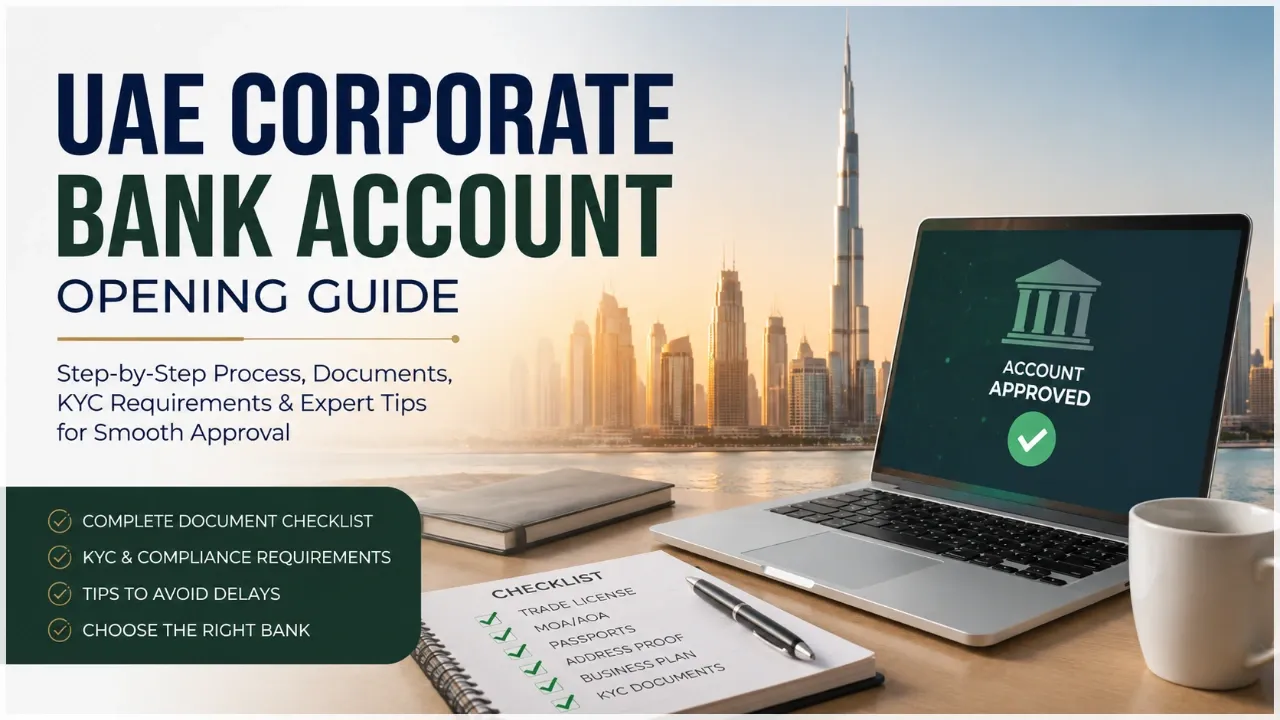
Comprehensive Document Checklist for Account Opening
Organizing your corporate and personal records before submitting an application is the most reliable way to expedite bank compliance review. The required documentation is divided into three primary categories:
1. Corporate Legal Documents
- Valid UAE Trade License: Issued by the Department of Economy and Tourism (DET) or the relevant Free Zone Authority.
- Certificate of Incorporation / Registration: Official proof of the entity's legal establishment.
- Memorandum and Articles of Association (MOA/AOA): Stamped and notarized corporate constitution detailing share distribution and operational powers.
- Share Certificate(s): Documenting individual shareholder equity allocations.
- Commercial Tenancy Contract (Ejari): Proof of physical office space or approved free zone business center agreement.
- Board Resolution: Official resolution from the board of directors authorizing the opening of the bank account and designating the authorized account signatories.
- Company Organogram: Clear structural chart detailing ownership tiers from top holding companies down to ultimate individual beneficiaries.
2. Personal Identification Documents (for all Partners, Directors, and Signatories)
- Valid Passport Copies: Clear color scans with at least six months of validity remaining.
- UAE Residence Visa and Emirates ID: For resident shareholders and signatories.
- UAE Entry Stamp: For non-resident shareholders visiting the country for banker signing meetings.
- Comprehensive Curriculum Vitae (CV / Resume): Detailed professional profile highlighting relevant business experience, industry background, and academic credentials.
- Personal Bank Statements: Last six months of personal bank statements from the home country or UAE bank demonstrating financial standing and investment capacity.
- Proof of Residential Address: Recent utility bill, tenancy contract, or municipal tax statement (issued within the last three months).
3. Business Background and Operational Proof
- Comprehensive Business Plan: Detailing company background, service/product descriptions, target market analysis, competitors, projected annual turnover, and estimated monthly transaction volumes.
- Draft Contracts or Letters of Intent (LOIs): Signed agreements or memorandums of understanding with potential suppliers and prospective clients.
- Sample Invoices and Quotations: Showing expected transaction formats, pricing structures, and payment terms.
- Website and Corporate Email Domain: Active professional website demonstrating legitimate business operations.
- Parent Company Profile (If Branch/Subsidiary): Audited financial statements, company profile, and active commercial registry of the overseas parent firm.
Step-by-Step Account Opening Process
Understanding the standard onboarding workflow ensures you are fully prepared at every stage of the banking engagement.
Step 1: Document Compilation and Pre-Screening
Assemble all required personal, corporate, and operational records into a coherent digital dossier. Reviewing the profile against bank-specific risk policies ensures that any potential ambiguities regarding funding sources or business activities are clarified beforehand.
Step 2: Account Type and Currency Selection
Determine your primary currency requirements. UAE banks standardly offer local Dirham (AED) accounts alongside major international trading currencies including US Dollars (USD), Euros (EUR), British Pounds (GBP), and Saudi Riyals (SAR).
Step 3: Application Submission and Compliance Profiling
The application is submitted through the bank's digital portal or directly via a commercial banking relationship manager. The bank inputs the data into its core compliance system to initiate background checks and name screening against global sanctions databases.
Step 4: Banker Meeting and Identity Verification
The designated authorized signatory must meet with a banking officer in person. During this meeting, the banker reviews original passports and Emirates IDs, observes physical signatures, and conducts an informal interview regarding the company's business model, customer base, and projected transaction flows.
Step 5: Compliance Review and Risk Assessment
The file moves to the bank's internal compliance and legal divisions for deep due diligence. The compliance team verifies the source of wealth, validates company website substance, and assesses counterparties mentioned in the business plan.
Step 6: Account Generation and Initial Deposit
Once compliance grants final approval, the bank issues the official International Bank Account Number (IBAN) and corporate account number. To activate online banking, chequebooks, and debit cards, the company completes the initial qualifying deposit in accordance with the selected account tier.
How to Ace the Banker Compliance Interview
The meeting with your commercial banking officer is a decisive moment in the onboarding process. Keep these practical communication guidelines in mind:
- Know Your Business Numbers: Be prepared to clearly state your anticipated monthly incoming turnover, average transaction size, and expected top suppliers and customers.
- Explain Your Commercial Footprint: Articulate why your business chose Dubai, who your local or regional clients are, and how you deliver your services.
- Demonstrate Industry Expertise: Emphasize your prior track record in the sector, showing that the new venture is backed by experienced leadership.
- Be Transparent Regarding Transaction Flow: Clearly outline which countries you will be receiving funds from and sending payments to, ensuring high-risk sanction-listed nations are completely avoided.
Practical Example: Successful Account Opening for a Tech Consultancy
A software engineering entrepreneur from the UK established a digital consultancy firm in Dubai:
- Preparation: The founder compiled their UK company track record, two years of verified personal bank statements, an attested degree, and three signed consultancy engagement agreements with regional clients.
- Substance: The business secured a dedicated flexi-desk in Dubai and launched a professional corporate website with corporate email addresses.
- Banking Route: The applicant selected a hybrid approach, securing a digital business account within five working days for immediate client billing while concurrently processing a tier-one commercial bank application for large cross-border trade transactions.
- Outcome: Both accounts were successfully activated without a single compliance query due to thorough upfront preparation.
Maintaining Your Corporate Account Post-Approval
Securing your bank account is a major milestone, but ongoing account maintenance is equally essential to prevent restrictions or freezing:
- Maintain Minimum Balance Thresholds: Consistently maintain the agreed average monthly balance to avoid penalty charges or automated account reclassification.
- Promptly Update Renewed Trade Licenses: Forward your renewed annual trade license, Ejari, and updated Emirates IDs to the bank's compliance team immediately upon annual renewal.
- Retain Underlying Commercial Documentation: Keep signed contracts, bills of lading, and verified invoices for all major incoming and outgoing wire transfers in case the bank requests transaction justification.
- Avoid Inactivity: Execute regular commercial transactions to prevent the account from being flagged as dormant.
Conclusion
Opening a corporate bank account in the UAE is a structured, systematic process that rewards meticulous preparation, absolute transparency, and clear demonstrable business substance. By selecting the appropriate banking institution, compiling an impeccable documentation file, and presenting a compelling commercial profile, you can establish an enduring banking partnership that powers the growth and global reach of your Dubai enterprise.
Frequently Asked Questions
1. How long does it typically take to open a corporate bank account in the UAE?
With complete documentation, verified source of funds, and clear business substance, account opening at traditional tier-1 UAE banks typically takes between two to four weeks. Digital business banks can often review and open accounts within one to two weeks.
2. Can a non-resident open a corporate bank account in Dubai?
Yes, foreign non-resident shareholders can open a corporate account for their UAE company. However, the authorized signatory must visit the UAE in person for biometric verification and passport validation with the banking officer.
3. What is the minimum balance requirement for UAE corporate bank accounts?
Minimum average monthly balance requirements vary widely depending on the bank and account tier. Traditional commercial banks typically require balances between AED 25,000 to AED 100,000 to avoid monthly maintenance fees, while specialized digital SME accounts offer lower balance thresholds.
4. Why do UAE banks reject corporate bank account applications?
Common rejection reasons include incomplete personal or corporate documentation, lack of demonstrable local economic substance, unexplained or unverifiable source of wealth, high-risk unvetted business activities, and inadequate business plans.
5. Are digital neobanks legally recognized for commercial business in the UAE?
Yes, digital business banking platforms licensed by the Central Bank of the UAE (such as Wio Bank) are fully regulated, secure, and legally recognized financial institutions offering official IBANs, multi-currency processing, and domestic/international wire transfers.
Need Assistance Opening Your Corporate Bank Account?
Our dedicated banking advisors assist with documentation compilation, comprehensive KYC profile structuring, and direct introductions to leading UAE commercial banks to ensure seamless account approval.
Get Corporate Banking Support