30
Aug
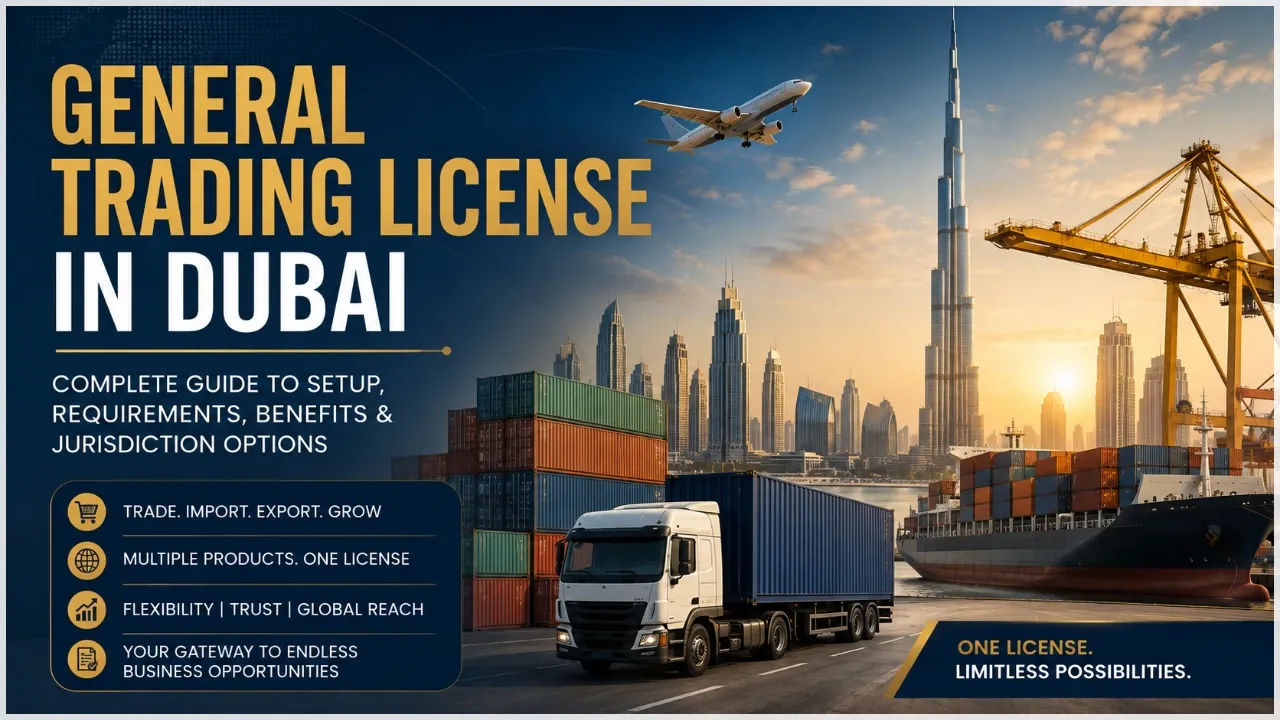
General Trading License in Dubai: Requirements, Scope, and Permitted Activities
For centuries, Dubai has flourished as a vibrant crossroads of global commerce, strategically bridging Eastern manufacturing powerhouses with Western consumer markets. Today, that historic trading spirit is backed by cutting-edge maritime ports, advanced air freight hubs, state-of-the-art customs automation, and an ultra-modern regulatory infrastructure. For international merchants, wholesalers, and supply chain enterprises, securing a General Trading License in Dubai represents the pinnacle of commercial flexibility and prestige.
Unlike standard commercial licenses that confine businesses to a single narrow product category, a General Trading License empowers companies to trade, import, export, store, and distribute a virtually limitless assortment of non-restricted goods under a single corporate banner. Whether managing multi-product consumer retail, supplying industrial hardware, or orchestrating high-volume international transshipments, this versatile license provides an unrivaled foundation for enterprise growth.
This detailed guide examines the scope, permitted activities, regulatory requirements, jurisdictional options, and step-by-step procedures involved in establishing a thriving General Trading company in Dubai.
What is a General Trading License in Dubai?
A General Trading License is an all-encompassing commercial authorization granted by the Department of Economy and Tourism (DET) in mainland Dubai or by prominent Free Zone Authorities. It permits a registered business to engage in wholesale, retail, import, export, and distribution of diverse, unrelated commodities within the same corporate structure.
Under a single General Trading license, an enterprise can simultaneously deal in:
- Consumer electronics, smart devices, and household appliances
- Textiles, apparel, footwear, and fashion accessories
- Packaged food products, beverages, and non-perishable consumables
- Furniture, lighting fixtures, and home decor items
- Construction materials, hardware, and plumbing supplies
- Automotive spare parts, lubricants, and vehicle accessories
- Cosmetics, perfumes, toiletries, and personal care products
- Paper goods, packaging materials, and office stationery
General Trading License vs. Specific Commercial Trading License
Understanding the distinction between a General Trading License and a Specific Trading License is crucial when planning your business strategy:
| Feature | General Trading License | Specific Trading License |
|---|---|---|
| Activity Scope | Multiple unrelated commercial product lines under one license | Restricted to a single defined category (e.g., Electronics Trading only) |
| Operational Flexibility | Exceptional; pivot into new product categories without modifying license | Requires formal license amendments and fees to introduce new product types |
| Market Perception | High prestige and credibility among international suppliers and banks | Standard commercial footprint suited for specialized boutique traders |
| Customs Operations | Unified import/export clearing for diverse product shipments | Customs clearance limited strictly to listed license activities |
Permitted Commercial Activities and Regulatory Exclusions
While a General Trading License offers vast commercial freedom, UAE authorities maintain clear boundaries regarding regulated and prohibited goods to protect public health, safety, and national security.
1. Standard Permitted Commodities
Businesses holding a General Trading license can trade freely in virtually all standard commercial commodities, including dry goods, FMCG products, consumer gadgets, machinery, tools, toys, sports equipment, industrial components, and luxury accessories.
2. Restricted Goods Requiring External Department Clearances
Certain sensitive product categories are excluded from standard general trading and necessitate dedicated specialized licenses along with strict ministerial approvals:
- Pharmaceuticals, medicines, and medical drugs: Regulated strictly by the Ministry of Health and Prevention (MOHAP).
- Weapons, firearms, defense equipment, and ammunition: Regulated by the Ministry of Defence and Dubai Police.
- Alcoholic beverages: Requires specialized police permits and local alcoholic beverage trade licensing.
- Crude oil, petrochemicals, and hazardous raw chemicals: Subject to strict Ministry of Energy and civil defense regulations.
- Live animals and agricultural plants: Regulated by the Ministry of Climate Change and Environment (MOCCAE).
Jurisdiction Comparison: Mainland vs. Free Zone
Selecting where to incorporate your General Trading entity dictates your distribution reach and warehouse logistics:
1. Dubai Mainland General Trading LLC
Issued by the Department of Economy and Tourism (DET), a Mainland General Trading license allows the company to:
- Distribute and sell goods directly to local retailers, supermarkets, construction firms, and private businesses across all seven Emirates.
- Open multiple commercial showrooms, retail stores, and headquarters anywhere in mainland Dubai.
- Lease industrial warehouses in key logistics centers such as Al Quoz, Ras Al Khor, Dubai Investment Park (DIP), and Al Qusais.
- Benefit from 100 percent foreign ownership under updated UAE commercial laws.
2. Free Zone General Trading Entity
Major international free zones—such as Jebel Ali Free Zone (JAFZA), Dubai Airport Freezone (DAFZA), Dubai Multi Commodities Centre (DMCC), and Ras Al Khaimah Economic Zone (RAKEZ)—offer tailored General Trading licenses with specific advantages:
- Direct proximity to major seaports (Jebel Ali Port) and international airports, drastically reducing freight transit times.
- Zero customs duties on goods stored inside designated free trade zones for international transshipment and re-export.
- Comprehensive on-site warehousing, cold storage facilities, and advanced logistics support infrastructure.
- Simplified administrative onboarding and swift company registration.
Step-by-Step Roadmap to Obtain a General Trading License
Establishing your General Trading company in Dubai follows an organized legal and regulatory sequence:
Step 1: Choose Company Structure and Jurisdiction
Decide whether a Mainland LLC or a specialized Free Zone FZ-LLC / FZE structure best aligns with your target market (domestic UAE supply vs. international transshipment).
Step 2: Reserve a Compliant Trade Name
Select and submit your corporate trade name for official approval. The trade name must end with the legal suffix (e.g., 'General Trading LLC') and adhere to government naming regulations.
Step 3: Secure Initial Approval
Submit the initial application to the DET or Free Zone Authority to confirm that the shareholders and business activities meet government guidelines.
Step 4: Draft and Notarize the Memorandum of Association (MOA)
Prepare the corporate MOA defining shareholder capital allocations, management powers, and operating rules. The MOA is executed digitally or notarized through Dubai Courts.
Step 5: Secure Commercial Office and Warehouse Premises (Ejari)
Lease suitable physical commercial office space and warehouse facilities to house your administrative operations and inventory. The lease must be registered through the official Ejari system.
Step 6: License Issuance and Registration
Upon final document verification and settlement of statutory government vouchers, the licensing authority issues your official General Trading License and Chamber of Commerce registration certificate.
Step 7: Register with Dubai Customs (Customs Client Code)
Register your new company on the Dubai Customs Mirsal 2 portal to obtain a dedicated Customs Client Code. This code is essential for processing international sea and air shipments, obtaining import/export clearance, and managing duty documentation.
Customs Operations and Operating Under the GCC Unified Customs Law
A central pillar of General Trading operations in Dubai is navigating cross-border trade and customs clearance. The UAE is part of the GCC Customs Union, which operates under the GCC Common Customs Law. Key customs fundamentals include:
- Customs Tariff Classification (HS Codes): Every commercial commodity imported must be classified accurately using Harmonized System (HS) codes to ensure correct duty assessment and regulatory compliance.
- Bill of Entry Processing: All incoming sea, air, and land cargo declarations must be submitted electronically through Dubai Customs' Mirsal 2 digital system prior to vessel or aircraft arrival.
- Customs Duty in Free Zones vs. Mainland: Goods imported into designated free zones (such as JAFZA or DAFZA) enter under a customs duty suspension regime. Customs duties (standard 5 percent) are only payable if and when the goods are cleared out of the free zone into mainland UAE or GCC markets.
- Transit and Re-Export Clearance: Cargo transiting through Dubai ports bound for non-GCC international destinations can be re-exported without incurring domestic customs tariffs, solidifying Dubai's role as a re-export gateway.
Warehousing Logistics Across Dubai's Industrial Clusters
Physical storage and rapid inventory movement are critical for general trading businesses. Dubai offers strategically located industrial and logistics districts:
- Al Quoz Industrial Area: Highly central location within Dubai city, ideal for fast urban distribution, showrooms, and light inventory storage.
- Ras Al Khor Industrial Area: Strategic proximity to central Dubai, wholesale markets, and major highway interchanges (E44 and E311).
- Dubai Investment Park (DIP): A master-planned commercial and industrial community equipped with advanced infrastructure, wide transport corridors, and modern logistics facilities.
- Dubai South Logistics District: Directly connected to Al Maktoum International Airport and Jebel Ali Port via a dedicated logistics corridor, engineered for multimodal air-sea freight operations.
Essential Post-Setup Operational Requirements
Once your General Trading license is issued, operationalizing your trade enterprise involves several key initiatives:
- Opening Corporate Bank Accounts: Establish corporate multi-currency accounts to handle trade financing, supplier telegraphic transfers (TT), and letters of credit (LC).
- Supply Chain and 3PL Partnerships: Secure dependable freight forwarding and warehousing partnerships across Dubai's major logistics hubs.
- VAT Compliance & Registration: General trading companies generating taxable turnover exceeding mandatory thresholds must register for UAE VAT, apply standard 5 percent VAT on domestic taxable sales, and zero-rate international exports.
- Corporate Tax Registration: Maintain audited financial records and file annual UAE Corporate Tax returns in compliance with federal tax regulations.
Practical Example: Regional Consumer Goods Distribution Hub
An international trade conglomerate incorporated a Dubai Mainland General Trading LLC:
- Strategy: The enterprise imports premium homeware from Europe and consumer electronics from East Asia.
- Logistics: Shipments arrive at Jebel Ali Port, clear customs smoothly using the company's Customs Client Code, and are consolidated in a central warehouse in Dubai Investment Park (DIP).
- Distribution: The company supplies leading retail department stores throughout Dubai and Abu Dhabi while simultaneously re-exporting container volumes to partner distributors in Saudi Arabia, Oman, and Kuwait.
- Advantage: The entire multi-category operation runs under a single General Trading license, eliminating the cost and administrative burden of maintaining separate individual licenses.
Conclusion
A General Trading License in Dubai offers unparalleled agility, global prestige, and extensive commercial reach. Backed by Dubai's world-class transportation infrastructure, strategic geographical position, and transparent regulatory frameworks, it is the ultimate vehicle for visionary merchants seeking to dominate regional commerce and global supply chains. By establishing the right jurisdictional structure and adhering to compliance standards, your trading company can thrive for decades to come.
Frequently Asked Questions
1. What is the primary advantage of a General Trading License over a Specific Trading License?
A Specific Trading License restricts your business to a single industry category (e.g., garments or electronics only). A General Trading License allows you to import, export, store, wholesale, and retail multiple entirely unrelated product lines under one unified license.
2. Is 100% foreign ownership allowed for a Mainland General Trading License in Dubai?
Yes, under the updated UAE Commercial Companies Law, foreign investors of all nationalities are permitted 100 percent foreign ownership of Mainland General Trading LLCs without requiring a local Emirati partner to hold majority shares.
3. Can a General Trading company import goods and store them in warehouses across Dubai?
Yes, a General Trading company can lease commercial warehouses in industrial hubs such as Al Quoz, Ras Al Khor, or Dubai South, import containers via Dubai ports, clear customs using its Customs Client Code, and distribute goods locally or regionally.
4. Which products are strictly excluded from a standard General Trading License?
Goods subject to special health, safety, security, or environmental controls (such as pharmaceuticals, medical drugs, alcoholic beverages, crude oil, weapons, ammunition, and hazardous chemicals) require separate specialized licenses and strict ministerial approvals.
5. What is the difference between Mainland and Free Zone General Trading setup?
A Mainland General Trading license allows unrestricted direct distribution to retail shops, supermarkets, and companies anywhere across the UAE domestic market. A Free Zone General Trading license is ideal for international import-re-export trade and requires local distributors to sell directly into the mainland market.
Ready to Establish Your General Trading Company in Dubai?
Our expert company formation consultants assist with activity structuring, Department of Economy approvals, MOA drafting, customs code registration, and trade license issuance.
Apply for General Trading License