15
Aug
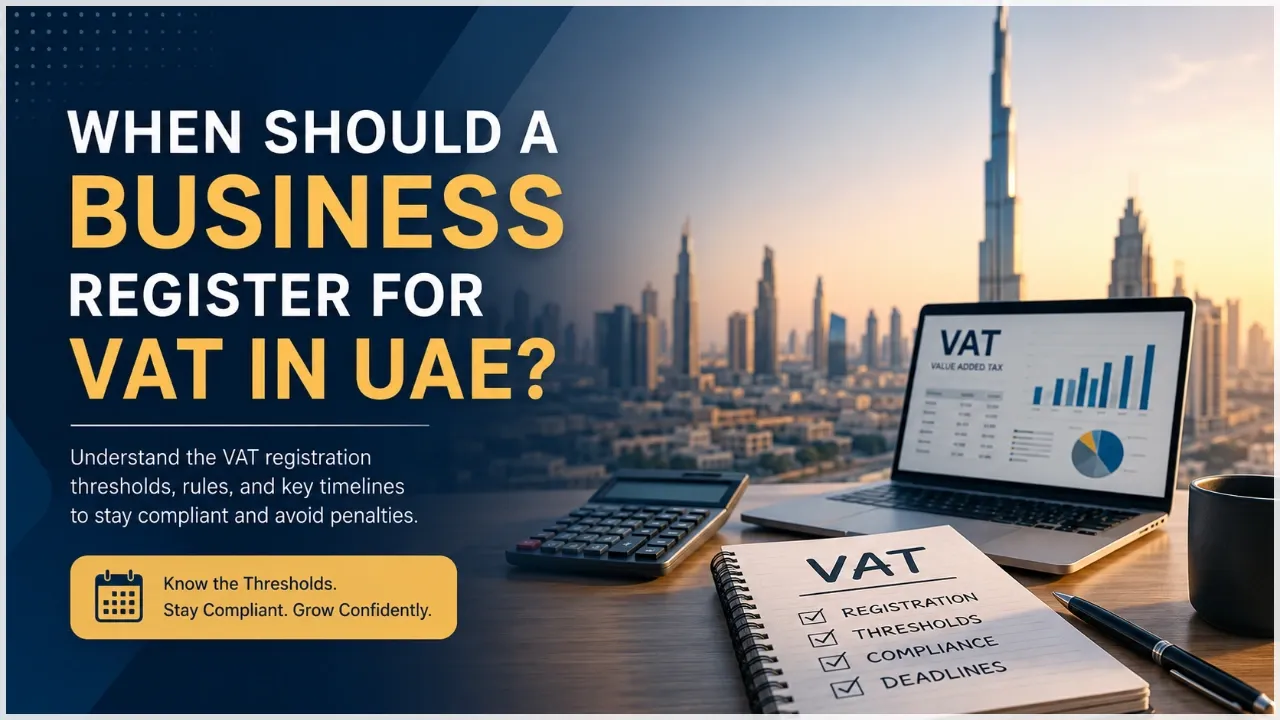
When Should a Business Register for VAT in UAE?
Running a business in the UAE comes with several tax and compliance responsibilities, and Value Added Tax (VAT) is one of the most important for growing businesses. Whether you operate from Dubai, Abu Dhabi, Sharjah, or another emirate, understanding when VAT registration becomes necessary can help you avoid penalties and manage your finances properly.
For UAE-resident businesses, VAT registration becomes mandatory when the value of taxable supplies and imports exceeds AED 375,000 over the previous 12 months or is expected to exceed this amount within the next 30 days. Businesses below this level may also qualify for voluntary registration when they cross AED 187,500 under the applicable rules.
This guide explains the VAT registration thresholds, how to know whether your business has reached them, when voluntary registration may make sense, and what to do once registration becomes necessary.
What Is VAT in the UAE?
VAT is a consumption tax applied to goods and services supplied in the UAE. The standard VAT rate in the UAE is 5%, although certain supplies may be zero-rated or exempt.
Businesses registered for VAT generally collect VAT from customers on taxable supplies and account for it to the Federal Tax Authority (FTA). They may also be able to recover eligible VAT paid on business expenses, subject to the applicable rules.
The important point for business owners is that VAT registration is not simply based on whether your company has a trade licence. It depends mainly on the nature and value of your taxable business activities.
The FTA defines taxable supplies for registration purposes as supplies of goods or services that may be taxed at either 5% or 0%, with certain imports also taken into consideration.
When Is VAT Registration Mandatory in the UAE?
For a UAE-resident business, VAT registration is mandatory when:
- The total value of taxable supplies and imports exceeds AED 375,000 during the previous 12 months; or
- The business expects the value of taxable supplies and imports to exceed AED 375,000 during the next 30 days.
The mandatory threshold is therefore not simply an annual turnover test based on the calendar year. Businesses need to monitor their taxable activities on an ongoing basis.
Example of the AED 375,000 Threshold
Imagine a Dubai-based marketing company has taxable sales as follows:
- Previous 12-month taxable sales: AED 310,000
- New contracts expected over the next month: AED 90,000
The business may reasonably expect its taxable supplies to cross AED 375,000 within the next 30 days.
In such a situation, the business should not wait until the end of the year to consider VAT registration. The expectation of crossing the threshold within the next 30 days can itself create a registration obligation.
What Is the Voluntary VAT Registration Threshold?
A business that has not reached the mandatory threshold may still be eligible to register voluntarily.
The voluntary registration threshold is AED 187,500.
A UAE-resident business may generally apply for voluntary registration when the value of its taxable supplies, imports, or qualifying taxable expenses exceeds AED 187,500 over the previous 12 months, or is expected to exceed that amount within the next 30 days.
Example of Voluntary Registration
Consider a small consulting business in Dubai with:
- Taxable sales: AED 150,000
- VAT-bearing business expenses: AED 50,000
If the business meets the applicable conditions, its qualifying amount may put it above the AED 187,500 voluntary registration threshold.
The owner could therefore consider voluntary VAT registration even though the business has not reached the AED 375,000 mandatory threshold.
Mandatory vs Voluntary VAT Registration
The difference can be understood simply:
| Registration type | Threshold | Is registration required? |
|---|---|---|
| Mandatory | More than AED 375,000 | Yes, if the applicable conditions are met |
| Voluntary | More than AED 187,500 | No, but the business may apply |
Both thresholds can be assessed using previous-period figures or reasonable expectations for the next 30 days, depending on the circumstances.
Does the AED 375,000 Threshold Apply to Every Business?
Not necessarily.
The rules for non-resident businesses can be different. According to the FTA, a non-resident business making taxable supplies in the UAE may be required to register for VAT regardless of the value of its supplies where there is no other person in the UAE responsible for accounting for the VAT.
This means a foreign company supplying goods or services into the UAE should not automatically assume that it can wait until its turnover reaches AED 375,000.
If your company is based outside the UAE but supplies customers in the UAE, it is important to assess the place-of-supply and VAT obligations based on the actual transaction structure.
What Counts Towards the VAT Registration Threshold?
The calculation is based on taxable supplies and relevant imports rather than simply looking at total money received in the business bank account.
Taxable supplies can include supplies subject to the standard 5% rate as well as qualifying zero-rated supplies. Imports can also be relevant when determining whether the registration threshold has been reached.
This is why business owners should not make a VAT registration decision based only on their sales invoices.
For example, a company may have:
- Standard-rated UAE sales
- Zero-rated supplies
- Imported goods
- Other transactions that may be exempt or outside the scope of VAT
Each category may receive different VAT treatment.
Does Free Zone Location Affect VAT Registration?
Being located in a UAE free zone does not automatically mean that the business is outside the VAT system.
The FTA states that businesses exceeding the mandatory registration threshold can be required to register whether they are based in a free zone or on the mainland.
Therefore, a business owner should not assume that having a free zone company means VAT registration is unnecessary.
The VAT treatment of individual transactions can depend on the nature of the free zone, the goods or services involved, and the specific transaction. Professional advice can be useful where the business has substantial free zone or cross-border activities.
When Should a Growing Business Register?
A business should start monitoring VAT registration well before it reaches AED 375,000.
Waiting until the business is already above the threshold can create unnecessary compliance pressure.
A practical approach is to:
- Track monthly taxable sales.
- Review the previous 12 months regularly.
- Monitor expected contracts and sales for the next 30 days.
- Separate taxable, zero-rated, exempt, and other transactions.
- Track relevant imports and qualifying expenses.
- Review whether the business is approaching AED 187,500 or AED 375,000.
- Prepare the registration documents in advance.
This is particularly important for businesses experiencing rapid growth.
Example: A Fast-Growing Dubai Business
Suppose a Dubai trading company recorded taxable sales of AED 280,000 over the last 12 months.
It has recently signed several new customer contracts worth AED 120,000 that are expected to be supplied within the coming month.
Although the business has not yet received all the money, its expected taxable supplies may mean it needs to consider mandatory VAT registration immediately.
The lesson is simple: VAT planning should happen before the threshold is crossed, not after.
How Do You Register for VAT in the UAE?
VAT registration is handled through the Federal Tax Authority's EmaraTax platform.
The general process involves:
- Creating and activating an EmaraTax account.
- Creating a taxable person profile.
- Accessing the taxable person's account.
- Selecting VAT registration.
- Completing the required information.
- Uploading the supporting documents.
- Submitting the application for FTA review.
The FTA currently provides these steps through its VAT registration service. Once approved, the VAT registration certificate is made available through the taxpayer's e-Services account.
Businesses should make sure that the information and supporting documents submitted are accurate and consistent with their actual business activities.
What Is the VAT Registration Deadline?
If a UAE business becomes required to register for VAT, it must submit its registration application to the FTA within 30 days of becoming required to register.
Missing the applicable registration deadline can result in penalties.
For this reason, businesses should monitor their turnover continuously rather than waiting for an accountant or auditor to identify the issue after the threshold has already been crossed.
Should a Small Business Register Voluntarily?
Voluntary registration can be useful in certain situations, but it is not automatically the best option for every small business.
Potential advantages may include:
- Ability to recover eligible input VAT on business expenses.
- Better preparation for future growth.
- Improved VAT compliance processes before mandatory registration becomes necessary.
- Having a VAT registration number when dealing with customers or suppliers that require it.
- Better handling of VAT-related costs for businesses with significant taxable expenses.
However, VAT registration also creates ongoing compliance responsibilities. A registered business must correctly charge and account for VAT where applicable, maintain appropriate records, issue compliant tax invoices where required, and meet its VAT filing and payment obligations.
Therefore, voluntary registration should be considered based on the business's financial position and future plans rather than simply because the AED 187,500 threshold has been reached.
What Happens After VAT Registration?
VAT registration is not a one-time administrative task.
After obtaining VAT registration, a business needs to build VAT into its regular accounting processes.
This can include:
- Issuing appropriate tax invoices.
- Recording output VAT collected from customers.
- Recording eligible input VAT on business purchases.
- Maintaining supporting documents.
- Keeping accurate accounting records.
- Preparing VAT returns.
- Paying VAT due to the FTA within the applicable deadlines.
- Monitoring changes in business activities and VAT treatment.
Good bookkeeping becomes especially important as the business grows.
Common VAT Registration Mistakes Businesses Should Avoid
Some common mistakes include:
Waiting Until the Threshold Is Clearly Crossed
Businesses sometimes wait until their annual sales are above AED 375,000. However, the rules also consider expectations for the next 30 days.
Looking Only at Bank Receipts
VAT threshold calculations are not simply a matter of checking deposits in the company's bank account. The nature of each supply matters.
Assuming Free Zone Businesses Are Automatically Exempt
A free zone company can still have VAT registration obligations.
Ignoring Imports
Relevant imports can contribute to the VAT registration calculation.
Treating VAT Registration as Only an Accounting Issue
VAT affects invoicing, pricing, bookkeeping, contracts, cash flow and compliance. It should be considered as part of the overall business management process.
Final Thoughts
VAT registration is an important compliance step for businesses operating in the UAE. For UAE-resident businesses, the key figure to remember is AED 375,000 for mandatory registration and AED 187,500 for voluntary registration, subject to the applicable VAT rules.
However, the calculation is more than simply adding up annual sales. Businesses need to consider taxable supplies, relevant imports, qualifying expenses for voluntary registration, and expected activity over the next 30 days.
If your business is growing quickly, regularly reviewing your VAT position can help you identify your obligations early and avoid last-minute compliance problems. The FTA provides the official registration process through EmaraTax, and businesses with complex transactions may benefit from professional VAT registration and compliance assistance.
Frequently Asked Questions
1. What is the mandatory VAT registration threshold in the UAE?
For UAE-resident businesses, the mandatory VAT registration threshold is AED 375,000. Registration is required when taxable supplies and imports exceed this threshold over the previous 12 months or are expected to exceed it within the next 30 days, subject to the applicable rules.
2. Can a business register for VAT before reaching AED 375,000?
Yes. A UAE-resident business may generally apply for voluntary VAT registration when its taxable supplies, imports, or qualifying taxable expenses exceed AED 187,500 over the previous 12 months or are expected to exceed that amount within the next 30 days.
3. Do free zone companies need VAT registration?
A free zone company is not automatically exempt from VAT registration. If the applicable VAT registration conditions are met, the business may be required to register regardless of whether it operates from a free zone or mainland.
4. How long does a business have to apply for VAT registration?
A person required to register for VAT must submit the registration application to the FTA within 30 days of becoming required to register.
5. Do UAE businesses have to register for VAT if their turnover is below AED 187,500?
Generally, a UAE-resident business that does not meet the mandatory or voluntary registration criteria does not need to register solely because it carries out business activities. However, special rules can apply to particular businesses, including non-resident businesses, so the specific circumstances should be reviewed.
Need Help With VAT Registration in the UAE?
Get professional assistance with VAT registration, FTA requirements, tax documentation, and ongoing VAT compliance for your UAE business.
Get VAT Registration Assistance