09
Jul
VAT Deregistration in the UAE: Eligibility, Deadline, Process and Penalties
Value Added Tax (VAT) registration is an important compliance requirement for businesses operating in the UAE. However, VAT registration is not always permanent. A business may close, stop making taxable supplies, or experience a significant reduction in taxable turnover. In such situations, the business may become eligible or required to cancel its VAT registration with the Federal Tax Authority.
VAT deregistration is a formal tax procedure. A business should not simply stop filing VAT returns because it has stopped trading or because its revenue has fallen. The VAT registration remains active until the required deregistration process is completed and approved.
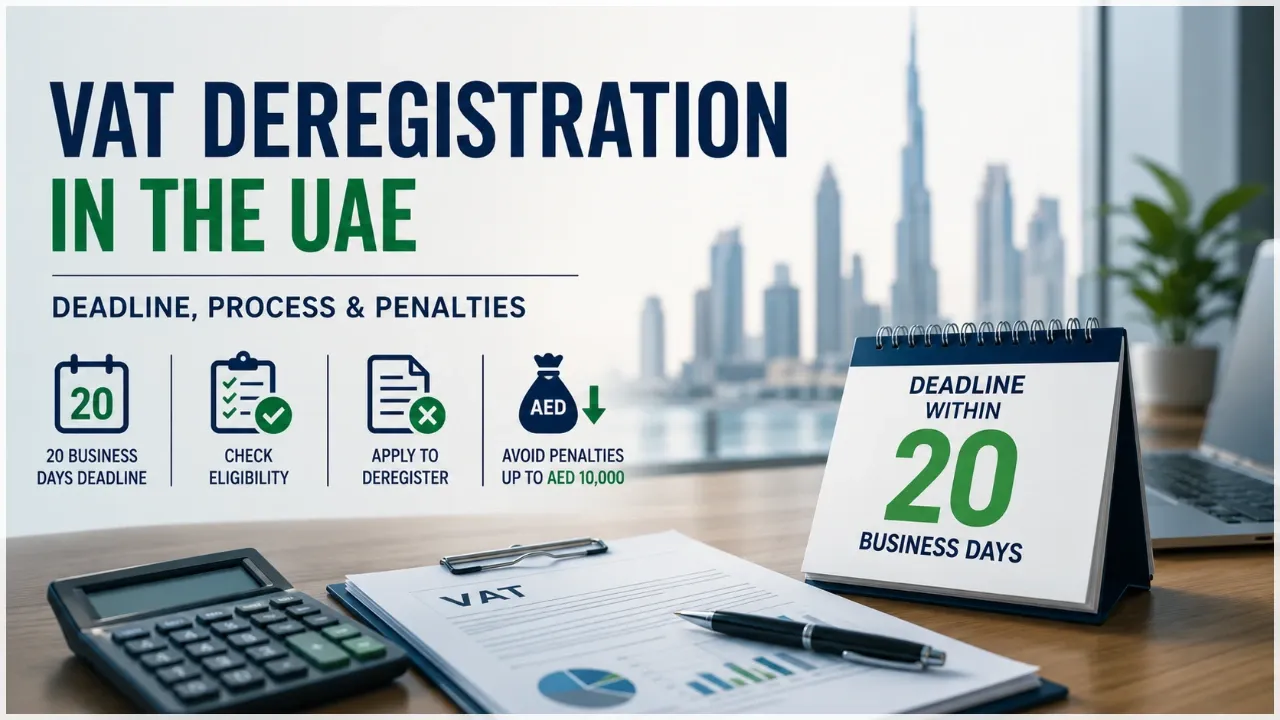
Timing is also important. Where VAT deregistration is mandatory, the application must be submitted within the applicable legal timeframe. The FTA's official material confirms the AED 187,500 voluntary VAT registration threshold, while current administrative penalty rules can result in a late-deregistration penalty of AED 1,000 per month or part thereof, capped at AED 10,000. (FTA UAE)
This guide explains VAT deregistration in the UAE, who may qualify, the importance of the 20-business-day deadline, the application process, common mistakes, and how professional VAT support can help businesses remain compliant.
What Is VAT Deregistration in the UAE?
VAT deregistration is the formal process of cancelling a business's VAT registration with the Federal Tax Authority.
When a business registers for VAT, it receives a Tax Registration Number, commonly known as a TRN. The registered business must then follow various VAT responsibilities, such as:
- Charging VAT where applicable
- Issuing proper tax invoices
- Maintaining accounting and VAT records
- Filing VAT returns within the required deadlines
- Paying VAT liabilities when due
- Following other relevant VAT compliance requirements
Deregistration brings the VAT registration to an end after the required process has been completed. However, applying for VAT deregistration does not mean that previous obligations disappear.
The FTA may still require the business to complete outstanding returns, settle unpaid liabilities and penalties, and provide supporting documents before the deregistration process can be finalized.
For this reason, businesses should treat VAT deregistration UAE as a proper compliance procedure rather than simply closing their tax account.
When Can a Business Deregister for VAT?
A business should first establish whether VAT deregistration is mandatory or voluntary under its circumstances. The correct position depends on the company's activities, taxable supplies, registration history and expected future turnover.
1. The Business Has Stopped Making Taxable Supplies
A business may be required to deregister if it has completely stopped making taxable supplies and does not expect to make taxable supplies during the relevant future period.
This commonly happens when a company:
- Permanently closes its business
- Cancels or liquidates the company
- Sells its entire business operation
- Stops the activity that generated taxable supplies
- Undergoes certain restructuring changes
For example, imagine a small trading company in Dubai that permanently closes its operations. It cancels its trade licence, stops all sales and has no plan to restart taxable business activities. The company's management should review its VAT deregistration obligations rather than simply stopping VAT return filings.
2. Taxable Turnover Falls Below the Relevant Threshold
Turnover is another important factor when reviewing VAT deregistration eligibility.
The FTA states that the voluntary VAT registration threshold is AED 187,500, while the mandatory VAT registration threshold is AED 375,000. The precise deregistration position depends on the circumstances and applicable VAT rules, so businesses should review both historical taxable supplies and realistic future expectations rather than relying on a single low-sales month. (FTA UAE)
For example, suppose a business had strong sales during its first few years but later lost a major contract. Its taxable turnover then falls substantially. Management should review the previous 12 months of taxable supplies and the expected business pipeline to determine whether VAT deregistration is required or permitted.
The 20-Business-Day VAT Deregistration Deadline
One of the most important parts of VAT deregistration is timing.
Where a business becomes required to deregister, it should determine the date on which the deregistration obligation arose and calculate the applicable filing deadline carefully. The material supplied for this article highlights the need to apply within 20 business days of becoming eligible where mandatory deregistration applies, making early review important.
This is not the same as 20 calendar days. Weekends and official holidays can affect the calculation, so businesses should not wait until the final days to prepare their application.
Why the Deadline Matters
A delay can create unnecessary compliance costs. Under the current penalty framework effective from 14 April 2026, failure to submit a deregistration application within the specified timeframe can attract a penalty of AED 1,000 for each month or part of a month of delay, up to AED 10,000. (ae.andersen.com)
Consider a simple example. A business becomes required to deregister but the owner assumes that cancelling the trade licence automatically cancels VAT registration. Several months later, the company discovers that the tax registration is still active.
By this point, the business may have:
- A late VAT deregistration exposure
- Outstanding VAT return requirements
- Unpaid tax liabilities
- Incomplete accounting records
- Additional administrative work
The better approach is to review tax registrations as part of any business closure, liquidation, restructuring or major reduction in activity.
Understanding VAT Deregistration Penalties
The current administrative penalty framework is designed to encourage businesses to complete tax procedures on time.
For late deregistration, the penalty structure is AED 1,000 for each month or part of a month in which the violation continues, with a maximum total of AED 10,000. (ae.andersen.com)
The important point for business owners is that waiting can make the problem more expensive. A delayed application should therefore be addressed as soon as it is identified.
Businesses should also remember that the deregistration penalty is separate from other possible VAT compliance issues. For example, if VAT returns remain outstanding or tax liabilities remain unpaid, those matters may need to be resolved separately.
Step-by-Step VAT Deregistration Process in the UAE
VAT deregistration is generally handled through the FTA's digital tax system. The exact information requested can depend on the reason for deregistration and the business's circumstances.
A practical process usually involves the following steps:
- Review eligibility: Confirm why the business is applying for deregistration and establish the date the obligation or eligibility arose.
- Review VAT records: Check taxable turnover, VAT returns, payments, outstanding liabilities and accounting records.
- Prepare supporting documents: Collect evidence supporting the reason for deregistration.
- Submit the application: Complete the deregistration request through the appropriate FTA online account.
- Respond to information requests: Provide any additional documents or explanations requested during the review.
- Complete outstanding obligations: File required returns and settle outstanding liabilities as applicable.
- Confirm completion: Check the account status and retain deregistration records and supporting documents.
A structured review before submission can reduce delays caused by inconsistent turnover figures, missing documents or unresolved VAT obligations.
Documents That May Be Required
The supporting documents required for a VAT deregistration application can vary. A company closing permanently may need different evidence from an active business applying because of reduced taxable turnover.
Depending on the situation, supporting information may include:
- Trade licence documents
- Business closure or liquidation evidence
- Financial statements
- Sales reports
- Turnover declarations
- VAT return records
- Bank statements
- Relevant invoices
- Proof supporting cessation of taxable activities
- Other documents requested during the application review
The key is consistency. The turnover figures in the application should be supported by the company's books and records.
For example, if a company claims that taxable turnover has dropped significantly, its sales reports, bank records and VAT filings should support that position.
Common VAT Deregistration Mistakes to Avoid
VAT deregistration may look simple, but several mistakes can cause delays or compliance problems.
Assuming Trade Licence Cancellation Cancels VAT Automatically
A trade licence and a VAT registration are separate matters. Business owners should review their VAT obligations directly rather than assuming that cancelling one registration automatically closes every government and tax account.
Waiting Too Long to Review Eligibility
Some businesses only think about VAT deregistration months after stopping operations. This can lead to avoidable penalties and additional compliance work.
A tax review should begin as soon as a business decides to close, sell, merge or significantly change its activities.
Using Incorrect Turnover Figures
Turnover calculations should be based on proper accounting records. Businesses should not use rough estimates or simply look at money received in a bank account.
The VAT analysis may require careful classification of transactions.
Ignoring VAT Returns During the Process
A pending deregistration application should not be treated as permission to ignore existing tax obligations. Businesses should continue following applicable requirements until the deregistration process has been formally completed.
Failing to Keep Supporting Records
Closing a business does not mean that tax records can immediately be discarded. Relevant accounting and VAT documentation should be retained for the applicable statutory periods.
Why Accurate Bookkeeping Matters for VAT Deregistration
Good bookkeeping makes VAT compliance easier at every stage of a business, including deregistration.
The project's SEO plan specifically identifies relevant services such as VAT registration Dubai, VAT filing services Dubai, bookkeeping services Dubai, UAE VAT consultant Dubai, FTA tax registration assistance Dubai, and accounting and compliance services Dubai.
Accurate bookkeeping helps a business determine:
- Its taxable turnover for the previous 12 months
- Whether turnover is genuinely declining
- Whether VAT returns agree with accounting records
- Whether any VAT liabilities remain unpaid
- Whether transactions have been classified correctly
- Whether the business has sufficient evidence for its application
For example, consider a small company that has not updated its accounts for six months. The owner believes that turnover is below the relevant threshold, but there is no reliable sales summary to support the calculation.
Before applying for deregistration, the company may need to bring its bookkeeping up to date. Otherwise, incorrect or incomplete information could delay the process.
Mandatory and Voluntary Deregistration: Why the Difference Matters
Not every business with reduced turnover has exactly the same deregistration obligation.
In some circumstances, deregistration may be mandatory. In others, the business may be allowed to apply voluntarily if the relevant conditions are met.
This distinction matters because the legal deadlines and effective dates depend on the circumstances.
A company should consider:
- Why it originally registered for VAT
- How long it has been registered
- Taxable supplies during the relevant period
- Expected taxable supplies
- Whether business activity has completely stopped
- Whether the legal entity is being closed or restructured
Businesses with unusual transactions, group structures or significant changes in activity may benefit from a detailed tax review before submitting the application.
How Professional VAT Deregistration Assistance Can Help
A VAT consultant can assist businesses by reviewing the complete tax position before an application is submitted.
Professional assistance may include:
- Checking deregistration eligibility
- Reviewing the effective date
- Calculating taxable turnover
- Checking VAT return history
- Identifying outstanding obligations
- Preparing supporting documents
- Assisting with the online application
- Responding to information requests
- Supporting final compliance work
This can be particularly useful for businesses with incomplete bookkeeping, multiple business activities, old VAT liabilities or complicated closure arrangements.
The aim is not simply to submit a form. The aim is to complete the deregistration process correctly and reduce the risk of future compliance problems.
When Should a Business Review Its VAT Registration Status?
VAT registration status should not be reviewed only when a business closes. Regular reviews are useful because business conditions can change.
A VAT status review is especially important when:
- Revenue drops significantly
- The business stops trading
- A company enters liquidation
- The business is sold
- A merger or restructuring takes place
- The company's main activity changes
- Management is uncertain whether VAT registration remains necessary
An annual VAT health check can help identify issues early, especially for small businesses where the owner handles several administrative responsibilities at once.
Conclusion
VAT deregistration in the UAE is an important compliance process for businesses that stop making taxable supplies or otherwise become eligible or required to cancel their VAT registration.
The process should be handled carefully. Businesses need to confirm their eligibility, determine the correct date, review turnover records, prepare supporting documents, submit the application within the applicable deadline and complete any outstanding VAT obligations.
The 20-business-day deadline is particularly important where mandatory deregistration applies. Under the current penalty framework, late VAT deregistration can result in an administrative penalty of AED 1,000 per month or part thereof, up to AED 10,000. (ae.andersen.com)
For businesses with incomplete records or uncertainty about eligibility, professional VAT and accounting assistance can make the process easier. Timely action, accurate bookkeeping and proper documentation are the best ways to complete VAT deregistration smoothly and remain compliant with UAE tax requirements.
Frequently Asked Questions
1. What is VAT deregistration in the UAE?
VAT deregistration is the formal process of cancelling a business's VAT registration with the Federal Tax Authority when the applicable legal conditions are met.
2. When should a business apply for VAT deregistration?
A business should review deregistration when it stops making taxable supplies, closes operations, or experiences changes in taxable turnover that may meet the legal conditions for mandatory or voluntary deregistration.
3. What is the deadline for mandatory VAT deregistration?
Where the deregistration obligation applies, the business should calculate and follow the applicable legal deadline. The supplied compliance material highlights a 20-business-day period for mandatory deregistration applications.
4. What is the penalty for late VAT deregistration?
Under the current administrative penalty framework, late deregistration can attract AED 1,000 for each month or part of a month of delay, capped at AED 10,000.
5. Can I stop filing VAT returns immediately after applying for deregistration?
Businesses should continue meeting applicable VAT obligations until the deregistration process is formally completed. Any outstanding returns, liabilities or information requests should be handled as required.
Need Help with VAT Deregistration?
Avoid unnecessary delays and compliance issues. Get professional assistance to review your VAT status, prepare the required documents and complete your VAT deregistration process accurately and on time.
Get VAT Assistance