21
Sep
Step-by-Step Guide to Drafting MOA and LSA Agreements in Dubai
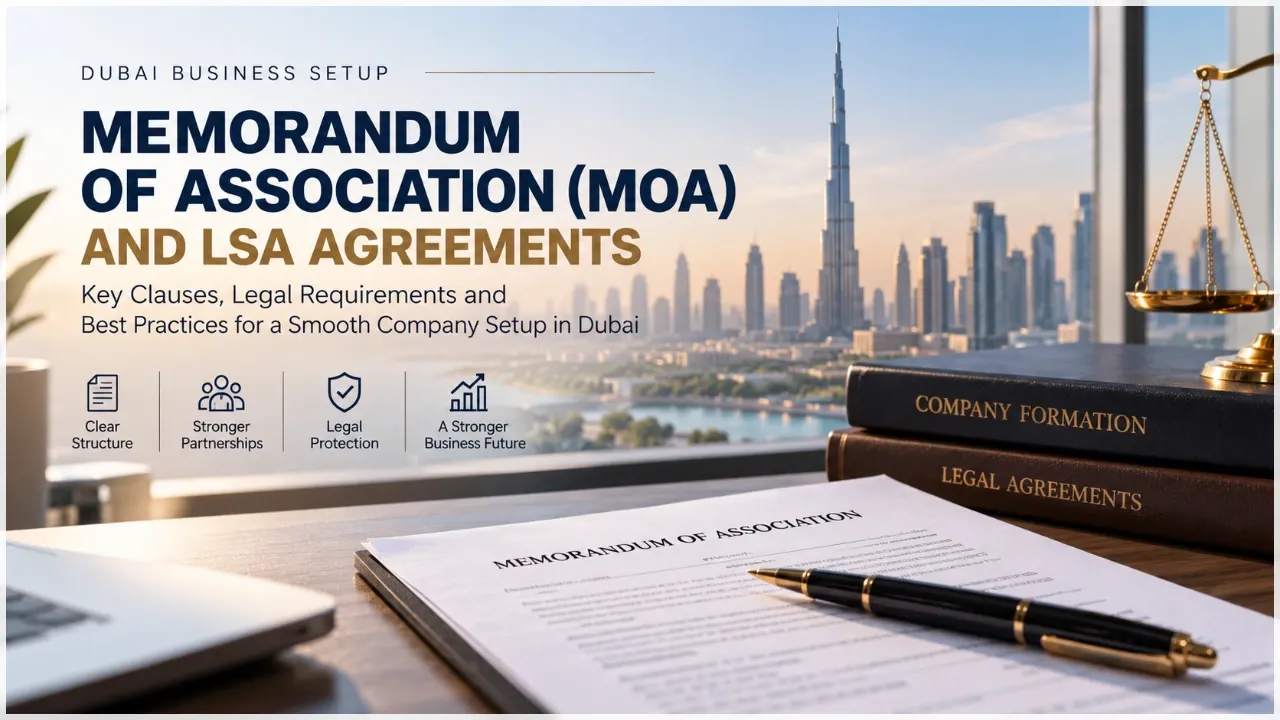
Establishing a commercial enterprise in Dubai requires translating business partnerships, capital commitments, and governance arrangements into legally enforceable corporate constitutional documents. Under Federal Decree-Law No. 32 of 2021 on Commercial Companies, the primary constitutional instrument governing multi-shareholder entities is the Memorandum of Association (MOA). For professional sole proprietorships or branches of foreign entities historically operating under civil frameworks, Local Service Agent (LSA) Agreements have traditionally defined representation roles. Drafting these foundational legal agreements with precision is one of the most critical legal milestones in the business setup process.
An MOA is not a standard administrative form; it is the binding charter that defines the entity's capital structure, shareholder ownership percentages, profit and loss allocations, managerial authorities, voting thresholds, and exit mechanisms. Ambiguities or generic phrasing in constitutional documents can lead to protracted shareholder deadlock, commercial litigation, or regulatory bottlenecks with the Department of Economy and Tourism (DET), commercial banks, and Dubai Courts. Engaging in meticulous drafting and understanding the modern digital notarization framework is essential for every entrepreneur establishing a corporate presence in the emirate.
The Legal Function of the Memorandum of Association (MOA)
The MOA represents the formal public contract between company shareholders. Under UAE law, a Limited Liability Company (LLC)—the most prevalent legal structure in mainland Dubai—cannot obtain a commercial trade license without an officially drafted, verified, and notarized MOA recorded in the commercial register.
A robust, legally sound MOA must address several mandatory statutory provisions:
- Entity Identification and Corporate Purpose: Stating the precise legal trade name in Arabic and English, registered office location, duration of the company, and comprehensive economic activities authorized by DET.
- Share Capital and Equity Distribution: Defining the authorized and paid-up capital of the company, division into shares of equal nominal value, and exact equity allocation between shareholders. Under current foreign ownership laws, foreign investors can hold 100% of the equity in mainland commercial and industrial entities.
- Managerial Appointment and Executive Powers: Explicitly designating the General Manager or Board of Directors and enumerating their operational, financial, and legal powers, including banking authority, contract signing limits, and representation before government bodies.
- Profit and Loss Distribution Ratios: Establishing how corporate dividends and financial liabilities are apportioned. UAE law allows profit distribution ratios to differ from equity ownership percentages, subject to statutory limits.
- Dispute Resolution and Liquidation Mechanisms: Outlining formal protocols for resolving partner disputes, deadlocks, share transfers, rights of first refusal, insolvency procedures, and voluntary company dissolution.
Understanding Local Service Agent (LSA) Agreements vs MOA
Entrepreneurs frequently encounter discussions regarding Local Service Agent (LSA) Agreements. Understanding the historical context and modern legal standing of LSAs is essential for structuring your enterprise correctly:
| Agreement Type | Governing Legal Scope | Modern Commercial Application |
|---|---|---|
| Memorandum of Association (MOA) | Governs equity ownership, managerial powers, and profit-sharing among partners in an LLC or partnership | Mandatory for all corporate entities with one or more shareholders (including Single-Owner LLCs) |
| Local Service Agent (LSA) Agreement | Appoints a UAE national agent to render administrative representation before government bodies without equity ownership | Historically required for foreign professional branches and sole proprietorships; largely made optional or phased out under 100% foreign ownership reforms |
Following landmark amendments to the UAE Commercial Companies Law, the mandatory requirement to appoint an LSA or local sponsor for professional sole establishments has been removed for the vast majority of economic activities in mainland Dubai. Foreign professionals can now own 100% of their professional and consultancy businesses without an LSA, simplifying corporate governance and eliminating recurring agency costs.
Crucial Clauses That Must Be Customized in an MOA
While standard DET electronic templates exist for rapid licensing, experienced corporate counsel strongly advise incorporating bespoke addendums and tailored clauses to protect shareholder investments:
- Banking and Financial Signing Mandates: Clearly specify whether the General Manager holds sole banking authority or whether joint signatures are mandatory for transactions exceeding defined monetary limits. Detail powers to open, operate, and close accounts, execute credit facilities, and pledge company assets.
- Pre-Emption Rights and Share Transfer Restrictions: Protect existing partners by establishing a mandatory Right of First Refusal (ROFR) should one shareholder wish to sell their equity. Require written consent from existing partners before any equity can be pledged or transferred to third parties.
- Quorum and Supermajority Voting Rules: Define specific majorities required to pass ordinary versus extraordinary shareholder resolutions. Fundamental decisions—such as increasing share capital, modifying company activities, appointing new managers, or amending the MOA—should mandate supermajority or unanimous approval.
- Non-Compete and Confidentiality Covenants: Restrict partners and executive managers from engaging in competing commercial activities within the UAE during their tenure and for a defined period following equity disposal.
Step-by-Step MOA Execution and Dubai Courts Digital Notarization
Executing an MOA in Dubai has been revolutionized by digital government initiatives. What once required in-person attendance at notary public offices can now be completed swiftly online through Dubai Courts digital notary portals.
Step 1: Legal Drafting and Multilingual Structuring
Draft the comprehensive MOA in both Arabic and English. Under UAE procedural law, Arabic is the official legal language. The English translation serves as a working reference, but in the event of any contractual discrepancy or litigation before Dubai Courts, the attested Arabic text legally prevails.
Step 2: Department of Economy and Tourism (DET) Review
Upload the draft MOA through the DET licensing portal alongside the initial approval certificate and trade name reservation. DET legal auditors review the document to ensure compliance with commercial activity parameters and company law standards.
Step 3: Dubai Courts Digital Notarization via UAE Pass
Once cleared by DET, the MOA file is transferred to Dubai Courts Notary Public systems. Shareholders receive automated SMS notifications prompting them to log in to the notary platform using their secure UAE Pass credentials. Each partner reviews the document and executes a digital electronic signature.
Step 4: Video Verification (When Applicable)
In cases involving high-value corporate restructuring, overseas shareholders signing via corporate Power of Attorney (POA), or specific legal forms, a brief video notarization session is conducted with a Dubai Courts notary officer to confirm identity and voluntary consent.
Step 5: Electronic Attestation and Trade License Integration
The notary public stamps the MOA with a digital legal seal and scannable QR verification code. The authenticated electronic MOA synchronizes automatically with the DET commercial registry, enabling immediate generation of the final Dubai Commercial Trade License.
Drafting Effective Deadlock Resolution and Share Transfer Restraints
One of the most consequential functions of a customized Memorandum of Association (MOA) is establishing governance protocols for commercial disputes and equity liquidations. In corporate structures with two equal 50-50 shareholders, business operations can grind to a catastrophic halt if partners disagree on major strategic decisions, capital calls, or bank financing.
To avoid debilitating operational paralysis, corporate founders should incorporate sophisticated deadlock resolution mechanisms into their MOA addendums. Recognized legal mechanisms include "Russian Roulette" or "Texas Shootout" buy-sell provisions, wherein one shareholder offers to buy out the other at a stated valuation, prompting the recipient to either accept the buyout or purchase the offering partner's shares at that exact valuation. Additionally, incorporating "Drag-Along" and "Tag-Along" clauses protects both majority and minority shareholders during third-party acquisition discussions, ensuring that minority owners cannot block a lucrative company sale while guaranteeing they receive identical commercial terms on their equity, fostering long-term corporate peace of mind.
Post-Execution Maintenance of Corporate Agreements
A company's MOA is a living corporate charter. Whenever partners introduce new investors, alter capital contributions, change trade names, add new business activities, or reassign managerial powers, a formal Amendment to the Memorandum of Association (Addendum) must be drafted, approved by DET, and notarized through Dubai Courts. Engaging specialized business setup and corporate legal consultants ensures that your corporate agreements protect your long-term commercial interests and provide an unshakeable governance foundation in Dubai.
Frequently Asked Questions
What is the primary difference between an MOA and an LSA agreement?
An MOA governs equity ownership, voting rights, and profit distribution among company partners, whereas an LSA agreement historically appointed a UAE national to provide administrative representation without holding company shares.
Is an LSA still mandatory for professional businesses in Dubai?
No. Under the amended UAE Commercial Companies Law, the mandatory requirement for a Local Service Agent (LSA) has been eliminated for most professional and consultancy licenses, enabling 100% foreign ownership.
Can an MOA in Dubai be notarized online?
Yes. Dubai Courts provides a streamlined digital notarization service allowing shareholders to authenticate and sign their MOA electronically using UAE Pass without visiting a physical notary office.
Which language prevails in a bilingual MOA in Dubai?
Under UAE legal practice, the Arabic text legally prevails before UAE judicial authorities and government registries in the event of any linguistic divergence or contractual dispute.
What happens if shareholders want to amend their MOA after licensing?
Any modification to company activities, shareholding structure, capital, or management requires drafting a formal MOA Amendment (Addendum), obtaining DET approval, and completing notarization through Dubai Courts.
Need Expert MOA Drafting and Notarization in Dubai?
Right Time Business Setup provides professional bilingual legal drafting for Memorandums of Association, shareholder agreements, and corporate amendments, along with complete Dubai Courts digital notarization support. Contact our legal specialists today.
Draft Your MOA