12
Jun
Corporate Tax vs VAT: Understanding the Difference
As the UAE continues to strengthen its tax and regulatory framework, businesses are becoming increasingly aware of the importance of understanding different types of taxes. Two of the most commonly discussed taxes in the UAE are Corporate Tax and Value Added Tax (VAT).
Many business owners, especially new entrepreneurs and startups, often confuse these two taxes. While both are government-imposed taxes and require compliance, they serve different purposes and apply in different ways.
Understanding the difference between Corporate Tax and VAT is essential for maintaining compliance, avoiding penalties, and making informed financial decisions.
In this guide, we will explain Corporate Tax and VAT in simple terms, compare their key differences, discuss how they affect businesses, and provide practical examples to help you understand your responsibilities.
What Is Corporate Tax?
Corporate Tax is a tax imposed on the profits earned by businesses.
Unlike VAT, which is collected from customers, Corporate Tax is based on the net profit generated by a company after deducting eligible business expenses.
Simply put, if a company makes a profit, it may be required to pay Corporate Tax on that profit according to applicable UAE regulations.
Why Corporate Tax Exists
Governments introduce Corporate Tax to:
- Generate public revenue
- Support economic development
- Improve business transparency
- Align with international tax standards
- Promote fair taxation
Corporate Tax is generally calculated based on annual business profits.
What Is VAT?
VAT (Value Added Tax) is an indirect tax applied to the sale of goods and services.
Unlike Corporate Tax, VAT is collected from customers when they purchase products or services.
Businesses act as tax collectors on behalf of the government by charging VAT and remitting it to the relevant authority.
Why VAT Exists
VAT helps governments:
- Generate revenue
- Tax consumption rather than income
- Diversify national income sources
- Support public services and infrastructure
VAT affects businesses differently because it applies to transactions rather than profits.
The Main Difference Between Corporate Tax and VAT
The simplest way to understand the difference is:
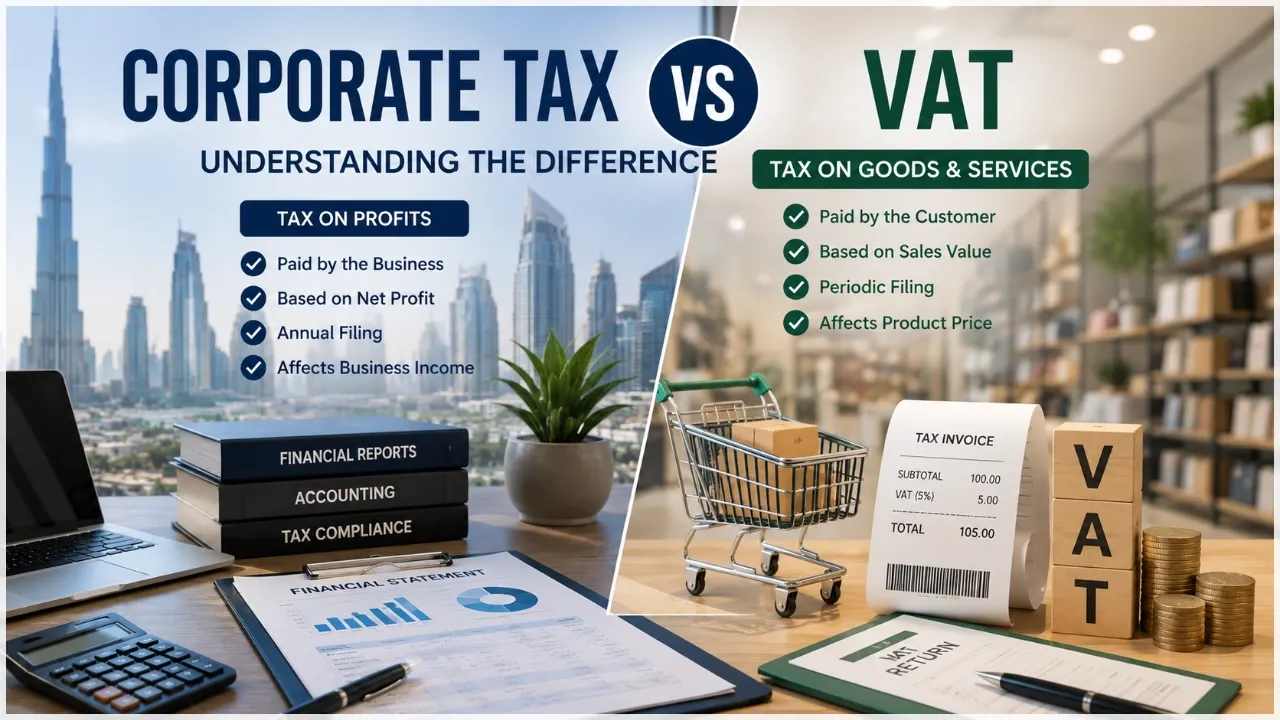
Corporate Tax
- Tax on business profits
- Paid by the company
- Calculated annually
- Based on net income
VAT
- Tax on sales of goods and services
- Paid by customers
- Collected by businesses
- Reported periodically
One tax focuses on profits, while the other focuses on transactions.
Corporate Tax vs VAT: Side-by-Side Comparison
| Feature | Corporate Tax | VAT |
|---|---|---|
| Applied On | Business Profit | Sale of Goods & Services |
| Paid By | Business | Customer |
| Collected By | Government from Business | Business from Customer |
| Based On | Net Profit | Transaction Value |
| Purpose | Tax Business Income | Tax Consumption |
| Reporting | Annual | Periodic VAT Returns |
| Impact | Company Profitability | Product Pricing |
This comparison helps illustrate why both taxes are treated differently in business accounting.
How Corporate Tax Works
Let's consider a simple example.
Example
A company earns:
- Revenue: AED 1,000,000
- Expenses: AED 700,000
Profit:
AED 300,000
Corporate Tax is generally assessed on the profit amount rather than total revenue.
This means the tax calculation is based on the company's financial performance after expenses are deducted.
How VAT Works
Now consider another example.
A business sells a product worth AED 1,000.
The customer pays:
- Product Price: AED 1,000
- VAT: AED 50
Total Paid:
AED 1,050
The AED 50 VAT amount does not belong to the business. The company collects it and later remits it to the tax authority.
This demonstrates the key difference between VAT and Corporate Tax.
Why Businesses Need to Understand Both Taxes
Many businesses are subject to both Corporate Tax and VAT obligations.
Understanding both helps with:
- Financial planning
- Compliance management
- Accurate bookkeeping
- Budget forecasting
- Risk reduction
- Avoiding penalties
Ignoring tax responsibilities can create significant financial and legal challenges.
Corporate Tax Compliance Requirements
Businesses may need to:
Register for Corporate Tax
Eligible businesses must complete tax registration procedures.
Maintain Financial Records
Proper accounting records are essential for accurate tax reporting.
Prepare Financial Statements
Financial reports help determine taxable profits.
Submit Tax Returns
Businesses must file Corporate Tax returns within the required deadlines.
Pay Corporate Tax
Any applicable tax liability must be paid according to regulations.
VAT Compliance Requirements
VAT-registered businesses typically need to:
Register for VAT
Businesses meeting registration requirements must obtain VAT registration.
Issue VAT-Compliant Invoices
Invoices should include the required VAT details.
Maintain VAT Records
Accurate transaction records are necessary for reporting.
Submit VAT Returns
VAT returns are filed periodically.
Pay VAT Liability
Collected VAT must be remitted according to applicable deadlines.
Common Mistakes Businesses Make
Many businesses encounter problems because they misunderstand the difference between Corporate Tax and VAT.
Mistake 1: Assuming They Are the Same
Corporate Tax and VAT are separate obligations with different calculations and reporting requirements.
Mistake 2: Poor Record Keeping
Incomplete records can lead to compliance issues.
Mistake 3: Missing Registration Deadlines
Late registration may result in penalties.
Mistake 4: Incorrect Tax Calculations
Errors can create financial and legal complications.
Mistake 5: Ignoring Professional Advice
Tax regulations can be complex, making expert guidance valuable.
How Bookkeeping Supports Tax Compliance
Proper bookkeeping forms the foundation of tax compliance.
Benefits include:
- Accurate financial records
- Easier tax calculations
- Better cash flow management
- Reduced audit risks
- Improved business insights
Without proper bookkeeping, businesses may struggle to comply with Corporate Tax and VAT requirements.
The Role of Tax Consultants
Professional tax consultants can help businesses:
- Understand obligations
- Register for taxes
- Prepare tax returns
- Maintain compliance
- Manage tax risks
- Improve reporting accuracy
This is especially valuable for startups and growing businesses.
Corporate Tax and VAT for Small Businesses
Many small business owners assume tax compliance only affects large companies.
In reality, small businesses must also understand:
- Registration requirements
- Record keeping obligations
- Reporting deadlines
- Tax planning considerations
Early compliance helps businesses avoid future complications.
Practical Example: A Trading Company
Imagine a trading company operating in Dubai.
The company:
- Purchases inventory
- Sells products to customers
- Generates annual profits
Its responsibilities may include:
- Charging VAT on eligible sales.
- Filing periodic VAT returns.
- Maintaining accounting records.
- Calculating annual profits.
- Filing Corporate Tax returns.
- Meeting all regulatory requirements.
This example shows how both taxes can apply to the same business but in completely different ways.
Benefits of Proper Tax Compliance
Businesses that maintain compliance often benefit from:
- Reduced penalties
- Better financial management
- Stronger credibility
- Improved investor confidence
- Easier audits
- Sustainable growth
Tax compliance should be viewed as an important business function rather than merely a legal obligation.
Conclusion
Corporate Tax and VAT are two fundamentally different taxes that serve different purposes within the UAE tax system. Corporate Tax applies to the profits earned by businesses, while VAT applies to the sale of goods and services and is ultimately paid by consumers.
Understanding the distinction between these taxes is essential for every business owner, whether operating a startup, SME, or large corporation. Proper bookkeeping, accurate record keeping, timely registrations, and professional guidance can help businesses remain compliant and avoid costly mistakes.
As tax regulations continue to evolve, businesses that invest in strong accounting and tax compliance processes will be better positioned for long-term success and sustainable growth.
Frequently Asked Questions
1. What is the main difference between Corporate Tax and VAT?
Corporate Tax is applied to business profits, while VAT is applied to the sale of goods and services and collected from customers.
2. Does every business need to register for VAT?
Registration depends on business activities and applicable registration requirements. Businesses should assess their eligibility carefully.
3. Is Corporate Tax calculated on revenue?
No. Corporate Tax is generally calculated on taxable profits rather than total revenue.
4. Can a business be subject to both Corporate Tax and VAT?
Yes. Many businesses have obligations related to both Corporate Tax and VAT compliance.
5. Why is bookkeeping important for tax compliance?
Bookkeeping helps maintain accurate financial records, supports tax calculations, simplifies reporting, and reduces compliance risks.
Need Help with Corporate Tax or VAT Compliance?
Our tax experts can assist with Corporate Tax registration, VAT registration, tax filing, bookkeeping, compliance reporting, and ongoing accounting support to keep your business fully compliant and financially organized.
Get Free Consultation